blog detail
- Home
- blog detail
 June 9, 2026
How Bilingual Education in Raebareli's CBSE Schools Is Building Stronger Communicators
The modern global economy values individuals who can communicate fluidly across different linguistic and cultural environments. Building stronger communication skills has become a key objective of secondary and senior secondary education, where fluency is no longer measured simply by a student's ability to read a textbook or memorize grammar rules. True communication requires cognitive flexibility—the capacity to analyze complex concepts in one language, synthesize information, and express ideas clearly in another.
For families researching the best CBSE school in Raebareli, the primary focus often centers on board examination results and competitive test readiness. However, forward-thinking parents are recognizing that the foundation of long-term academic and professional success lies in advanced language development.
By implementing structured, bilingual educational frameworks, premium CBSE schools in Raebareli are transforming classrooms into spaces that build highly articulate, future-ready communicators.
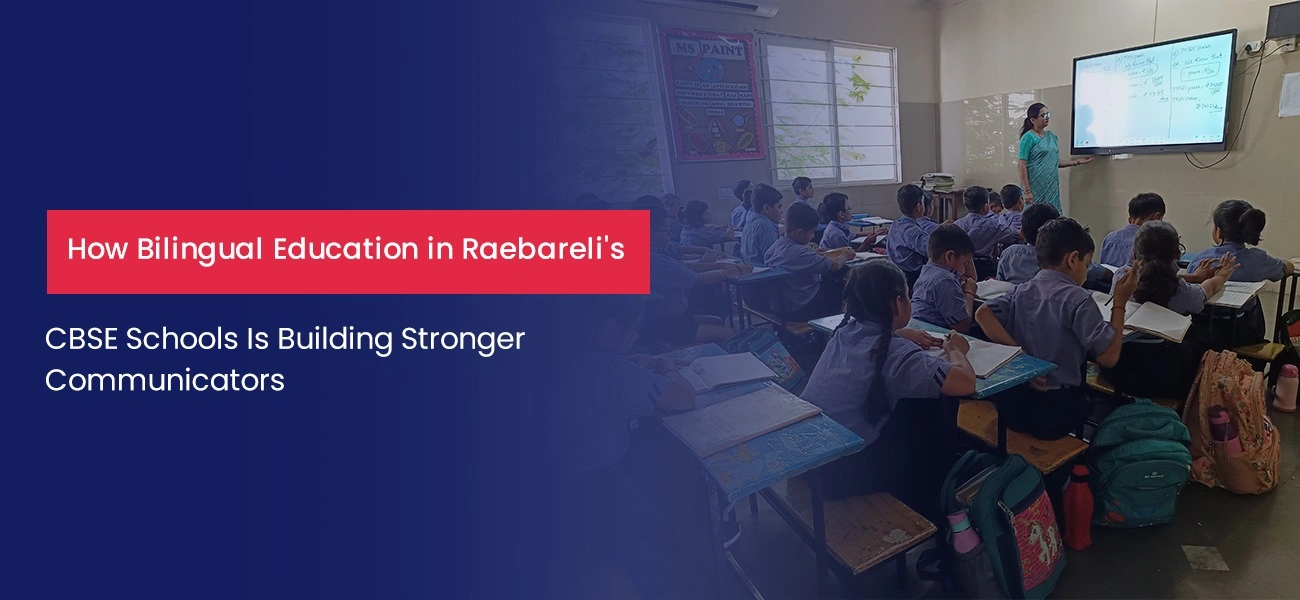
The Cognitive Architecture of Bilingual Learning
Bilingualism affects the brain in profound structural ways. When a child routinely switches between two languages—such as navigating scientific terms in English while discussing historical narratives or moral values in Hindi—their brain experiences a continuous mental workout. This constant shifting strengthens the brain's executive control system, which manages critical tasks like filtering distractions, switching focus between projects, and working through complex problems.
Rather than creating cognitive confusion, learning in two languages expands a student's conceptual vocabulary. A child who masters bilingual expression learns to view problems from multiple perspectives, realizing early on that a single idea can be framed in several different ways. This linguistic agility directly improves reading comprehension, abstract reasoning, and empathetic communication, giving students a clear advantage in higher education.
Why the CBSE Curriculum Supports Advanced Language Development
The Central Board of Secondary Education (CBSE) framework provides an ideal foundation for bilingual mastery. Designed to match international benchmarks while respecting regional cultural identities, the syllabus integrates language development directly into core academic subjects.
- Standardized Multilingual Training: The CBSE curriculum requires early, structured study of multiple languages, ensuring that students develop strong reading, writing, and speaking skills in both English and vernacular languages.
- Integrated Applied Learning: Rather than teaching language through isolated grammar drills, the board emphasizes active comprehension, creative composition, and public speaking across all academic streams.
- National Entrance Compatibility: Because major national selection tests like JEE, NEET, and CUET place a heavy premium on precise analytical reading, the strong language skills built in CBSE classrooms protect students from costly interpretation errors during high-stress exams.
The LPS Advantage: Shaping Clear Communicators in Raebareli
When evaluating institutions that successfully turn these structural advantages into real-world student success, Lucknow Public School (LPS) stands out as a clear leader. Operating two premier campuses in the region—the specialized Ahiyaraipur branch and the early learning foundation center at Pragati Puram—LPS has set the standard for academic excellence, discipline, and holistic growth since its regional expansion.
True to its foundational motto, “Discipline and Quality Education,” Lucknow Public School moves far beyond standard classroom memorization. The institution creates an immersive, active learning environment where language serves as a tool for real-world exploration and leadership.
1. Interactive Classrooms and Analytical Faculty
At LPS, language learning is deeply embedded in everyday science, math, and humanities classes. Our highly experienced, specialized faculty utilize digital smart classrooms and interactive teaching methods to ensure students don't just hear words, they actively apply them to real-world scenarios. This continuous usage builds deep academic confidence and helps students master technical terms naturally.
2. Comprehensive Co-Curricular Programs
To build true communication confidence, language must be used outside of traditional written exams. LPS integrates structured public speaking, inter-branch debating tournaments, dramatic arts, and literary clubs directly into its core educational model. These activities encourage students to step out of their comfort zones, organize their thoughts logically, and present ideas with poise and authority.
3. Future-Ready Global Exposure
As a premier best school in Raebareli, LPS offers exceptional opportunities for international engagement, including structured student exchange programs across Europe, Asia, and the Americas. This unique exposure lets students test their communication skills on a global stage, teaching them to collaborate across cultural boundaries and prepare for success in an interconnected world.
Framework Comparison: Rote Learning vs. Immersive Bilingual Curation
| Educational Milestone | Traditional Monolingual Rote Methods | The Lucknow Public School Standard |
| Language Acquisition | Dependent on dry grammar rules and passive text translation. | Active, bilingual classroom integration across all academic disciplines. |
| Public Speaking | Restricted to a small group of students during annual events. | Weekly classroom debates, continuous presentations, and assembly leading. |
| Conceptual Evaluation | Testing focused heavily on repeating memorized textbook definitions. | Skill-oriented assessments that prioritize critical thought and reasoning. |
| Global Readiness | Localized academic focus with minimal exposure to external cultures. | International ties and exchange paths that build cross-cultural confidence. |
Invest in Your Child's Communicative Leadership
Enrolling your child in a senior secondary school means choosing the environment that will shape their adult mind. Their school experience should be a structured, enriching, and inspiring journey that protects their natural curiosity, ensures strong board exam results, and builds the lifelong communication confidence needed to navigate tomorrow's opportunities.
Choosing a trusted, highly experienced institution ensures your child avoids academic gaps, hits key development milestones, and grows into an articulate leader ready to contribute meaningfully to society.
Give your child the gift of clear, global expression.

Written by:Kundan Yadav