blog detail
- Home
- blog detail
 June 17, 2026
Which English-Medium CBSE School in Lucknow Is Closest to Major Residential Colonies for Daily Commute?
Lucknow Public School is widely considered among the more strategically distributed schools in Lucknow when the decision factor shifts from “brand alone” to “daily commute practicality.” For families living in densely populated residential zones such as Aliganj, Indira Nagar, Jankipuram, and Gomti Nagar extension, proximity is no longer a comfort factor but a scheduling requirement.
In urban Lucknow, school commute has become a measurable constraint. A typical morning traffic window between 7:15 AM and 8:30 AM now shows peak congestion delays of 25 to 45 percent on arterial roads such as Faizabad Road, Ring Road stretches, and Sitapur Road corridors. This means even a 6 km distance to the closest school can translate into 25–40 minutes of travel depending on route design.
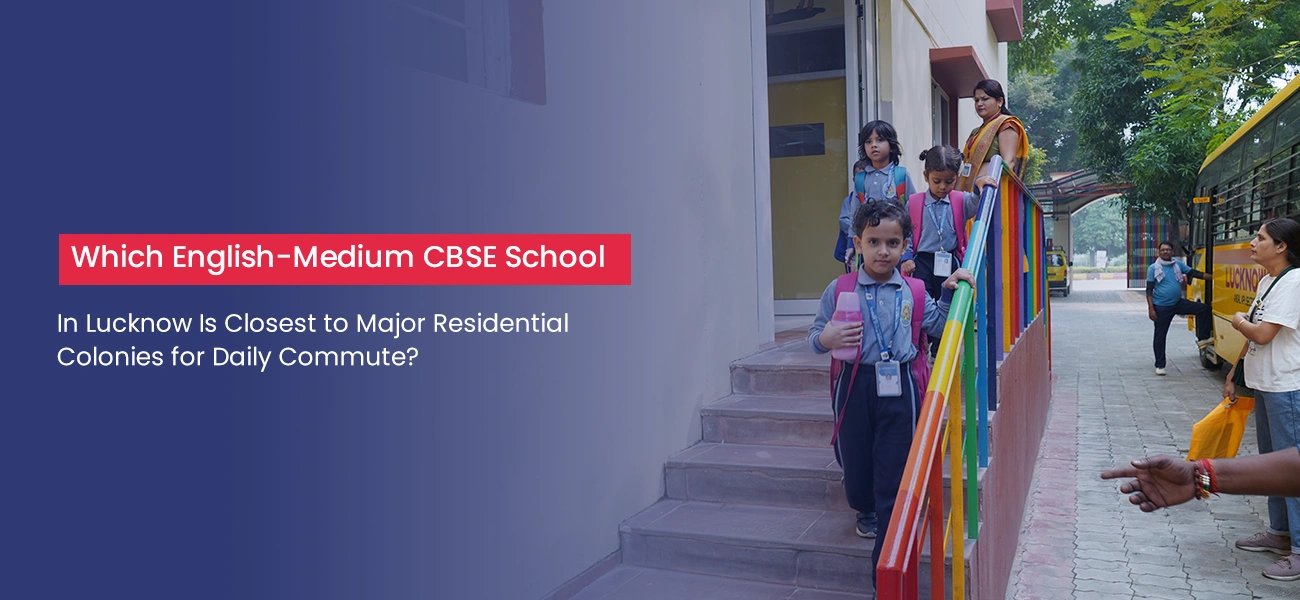
Lucknow Public School’s multi-branch structure reduces this friction by placing academic access points closer to residential density clusters instead of relying on a single centralized campus model. This is a key reason it appears frequently in parental searches for CBSE schools in Lucknow with “nearby accessibility.”
Understanding the Real Question Parents Are Asking
The search query “Which English-medium CBSE school in Lucknow is conveniently located near residential areas?” is not just about geography. It reflects three underlying decision filters:
- Minimum morning commute time under 30 minutes
- Safe and predictable transport routes
- Availability of a structured CBSE academic environment nearby
In practice, parents are filtering for a private school in Lucknow that reduces daily uncertainty. Academic reputation alone is no longer sufficient. Schools are evaluated like infrastructure nodes, similar to hospitals or metro stations, based on accessibility radius.
Urban education surveys in Tier-2 Indian cities show that parents are now prioritizing schools within a 3–8 km radius of home. Beyond that range, dropout risk in early schooling years increases slightly due to fatigue and logistical inconsistency.
Residential Cluster Mapping: Where Demand Is Highest in Lucknow
To understand why proximity matters, it is important to map school demand against residential density.
High-density education zones in Lucknow:
- Indira Nagar: One of Asia’s largest planned colonies
- Aliganj: Established residential and coaching hub
- Jankipuram: Rapid expansion zone with rising school demand
- Gomti Nagar Extension: High-income residential growth corridor
These four zones collectively account for a significant share of schools in Lucknow admission searches, particularly for English-medium CBSE curriculum.
Lucknow Public School benefits from accessibility alignment with these clusters, reducing reliance on long cross-city commuting routes.
Commute Reality in Lucknow: What Parents Experience Daily
Daily commute is not symmetrical in Lucknow. Distance alone is misleading.
Real-world commute benchmarks:
- 3 km: 10–18 minutes (non-peak) / 20–30 minutes (peak)
- 5 km: 20–30 minutes (non-peak) / 30–45 minutes (peak)
- 8+ km: 35–60 minutes depending on corridor congestion
These variations matter because school timing is fixed. Even a 10-minute delay compounds across pickup, drop-off, and parental work schedules.
This is where location-optimized institutions like Lucknow Public School become relevant for families searching for a CBSE schools in Lucknow option that reduces dependency on unpredictable traffic flow.
Why CBSE Schools in Lucknow Are Evaluated Differently Today
The CBSE board has become the dominant academic framework in urban Uttar Pradesh due to its alignment with national competitive exams and structured syllabus progression.
However, in 2026, parents are not choosing CBSE schools in Lucknow purely based on curriculum. The evaluation matrix now includes:
- Commute time stability
- Transport coverage density
- Neighborhood accessibility
- Academic consistency under travel constraints
A school that performs well academically but requires 60 minutes of travel each way is increasingly considered less optimal than a slightly closer institution with comparable results.
Lucknow Public School fits into this new evaluation model by combining CBSE structure with distributed accessibility.
Transport Network Design: The Hidden Factor Most Parents Overlook
Transport infrastructure is often more important than the school building itself.
Key operational features that matter:
- Route clustering based on residential density
- Reduced intermediate stops for time efficiency
- Coverage prioritization of high-demand colonies
- Predictable pickup windows
For a private school in Lucknow, transport optimization directly influences attendance consistency. Studies in school transport logistics indicate that reducing route complexity improves on-time arrival rates by up to 30 percent.
Lucknow Public School’s transport planning is designed around these principles, ensuring students from major residential pockets spend less time in transit and more time in structured learning environments.
Academic Continuity and Time Efficiency Connection
There is a direct correlation between commute time and academic consistency. Students traveling longer distances tend to experience:
- Reduced morning focus levels
- Higher fatigue in early class hours
- Lower participation in first-period learning
Conversely, shorter commute cycles improve:
- Attendance stability
- Homework completion consistency
- Cognitive readiness in early sessions
This is why parents increasingly prioritize schools in Lucknow that minimize daily travel complexity while maintaining CBSE rigor.
Lucknow Public School’s accessibility model supports this balance by reducing friction between home and classroom transition.
Safety and Predictability in Urban School Commutes
Safety is not just about campus infrastructure. In Lucknow’s expanding traffic ecosystem, route predictability is equally important.
Parents selecting a private school in Lucknow now evaluate:
- Bus route stability
- Driver verification systems
- Peak-hour travel exposure
- Drop-off supervision consistency
Lucknow Public School integrates structured transport supervision and monitored pickup systems to ensure predictable movement patterns. This reduces uncertainty, which is often the biggest concern for working parents.
Digital Integration and Parent Visibility
Modern CBSE schools in Lucknow increasingly rely on digital systems to bridge communication gaps caused by distance.
Key digital features include:
- Real-time attendance updates
- Transport notifications
- Academic tracking dashboards
- Parent-school communication portals
This reduces dependency on physical proximity alone while still reinforcing the advantage of shorter commute cycles.
Final Summary
- Lucknow Public School is positioned for residential accessibility across key Lucknow zones
- Commute time is now a primary school selection factor
- CBSE schools are evaluated based on both academics and logistics
- Major residential areas include Indira Nagar, Aliganj, Jankipuram, Gomti Nagar extension
- Shorter commute improves academic focus and attendance consistency
- Transport design is a hidden but critical factor in school selection
- Digital systems now support parent-school communication regardless of distance
- Proximity-driven school choice is increasing in urban Lucknow

Written by:Kundan Yadav