blog detail
- Home
- blog detail
 Sep 17, 2026
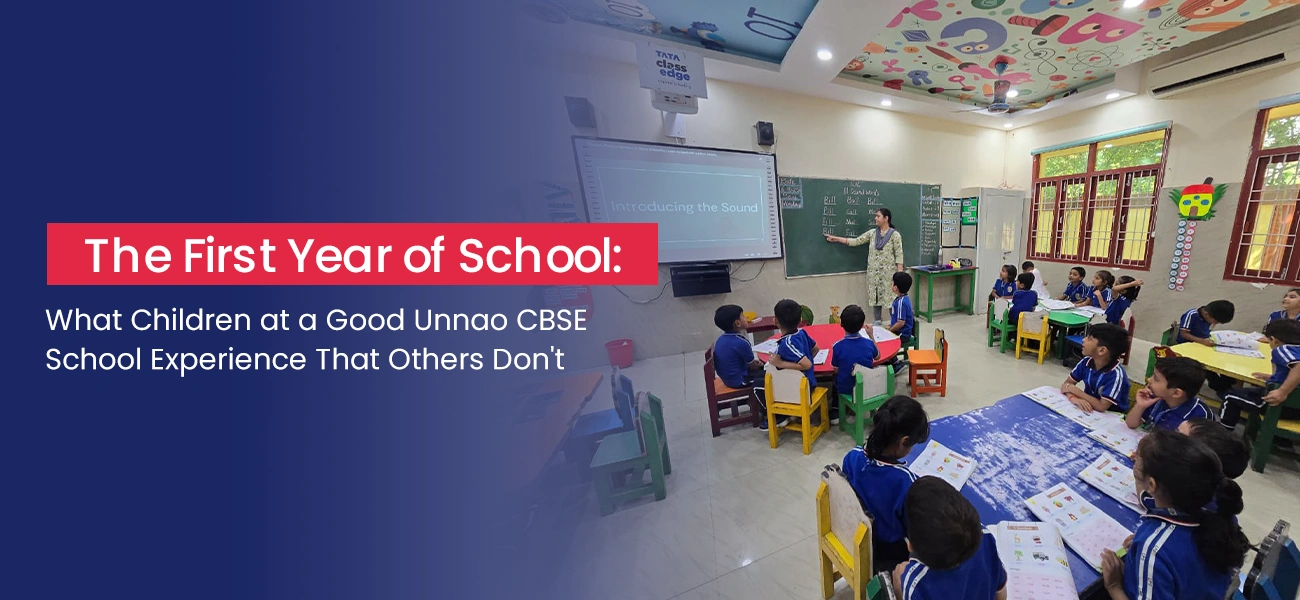
The First Year of School: What Children at a Good Unnao CBSE School Experience That Others Don't
The first year of school is much more than learning alphabets, numbers, and rhymes. It is when children begin to understand routines, make friends, follow instructions, express feelings, and feel comfortable away from home. For parents, this stage can bring many questions. Will my child enjoy school? Will teachers understand their needs? Will learning feel stressful or exciting? These questions matter because early school experiences can shape how children approach learning later. UNICEF notes that the early years are a critical period for development. It also highlights the importance of quality early learning, play, responsive adults, and a smooth transition into formal education.
What Should the First Year of School Really Offer?
A strong first year should help children settle, explore, communicate, and slowly become independent. For families looking for the best school in Unnao, these everyday experiences can be more important than impressive buildings or long lists of activities.
A Gentle Start to School Life
- Children learn classroom routines through repetition, helping them understand where to sit, when to listen, how to organise belongings, and how to participate confidently.
- Teachers create familiar patterns through greetings, stories, activities, and group work, making the classroom feel predictable rather than confusing.
- Children gradually learn that asking questions is acceptable, mistakes are part of learning, and trying again is more important than getting everything right.
This kind of transition matters. The Education Endowment Foundation identifies entry into early education as an important transition point that can affect learners, families, and settings.
Learning Through Play, Stories and Activity
Young children do not learn best by sitting quietly for long periods. They need chances to move, talk, observe, create, and experiment.
This is one reason the best school in Unnao should look beyond worksheets and memorisation.
Learning That Feels Natural
- Stories help children build vocabulary while encouraging listening, imagination, memory, and the confidence to speak in front of classmates.
- Games with numbers, shapes, objects, and patterns can introduce early mathematical thinking without making young children feel they are preparing for an examination.
- Drawing, music, movement, role play, and simple classroom tasks allow children to learn through different forms of expression.
UNICEF explains that play supports cognitive, physical, social, emotional, and creative development. It also describes play as a natural way for children to explore their world.
Building Independence From the First Year
Can a five-year-old really become independent at school? Yes, but independence develops through small daily opportunities.
A thoughtful classroom does not expect children to manage everything immediately. It gives them manageable responsibilities.
- Children may learn to keep their materials in place, follow simple instructions, wait for their turn, and complete small classroom responsibilities.
- Teachers can encourage children to make simple choices, solve minor problems, and ask for help when they genuinely need it.
- These small habits gradually build confidence and help children understand that they can manage new situations.
The National Education Policy 2020 places strong importance on quality early childhood care and education because the early years form the foundation for later learning.
Why Social Skills Matter as Much as Early Academics?
A child's first year is also their first regular experience of being part of a larger group.
At the best private school in Unnao, parents should look for opportunities that help children communicate, cooperate, and respect others rather than focusing only on written work.
Learning to Be Part of a Group
- Group activities teach children how to share materials, listen to different opinions, wait patiently, and work towards a common classroom goal.
- Simple conversations and collaborative tasks help children practise language while learning how to express their needs in respectful ways.
- Teachers can notice changes in behaviour early and work with families when a child needs additional encouragement or support.
UNESCO identifies social-emotional skills alongside literacy and numeracy as core elements of foundational learning.
This is why the first year should develop the child as a learner and as a person.
What Can a Well-Planned LPS Experience Add?
The approach followed by Lucknow Public School connects early learning with activity, exploration, and a comfortable school environment. Its Unnao-focused primary education content highlights a pre-primary No Bag System, activity-based learning, storytelling, musical expression, interactive classrooms, junior computer labs, and opportunities for sports and creative activities.
More Than Classroom Learning
- A No Bag System in pre-primary can reduce the physical load of carrying books while allowing young learners to participate in planned classroom activities.
- Interactive learning tools can help teachers present concepts through visual and engaging formats, especially when children are still developing their ability to understand abstract ideas.
- Exposure to sports, theatre, creative arts, and other activities gives children different ways to discover interests and express themselves.
The LPS branches in Unnao give local families access to the school group's approach through its Sector B and Sector C campuses. The official contact page lists both campuses in Priyadarshini Nagar.
Teachers Make the Biggest Difference
Facilities can support learning, but teachers shape the daily experience. A child may remember a colourful classroom, but they are more likely to remember the teacher who listened when they were nervous, encouraged an answer, or helped them try again.
- Good early-years teachers observe children closely instead of expecting every child to learn at exactly the same pace.
- They use questions, stories, activities, and conversations to understand what children know and where they need support.
- They also communicate with families so that learning habits and concerns can be understood beyond the classroom.
UNICEF's India Early Childhood Education Impact Study followed around 14,000 four-year-olds across Assam, Rajasthan, and Telangana, making it one of India's major longitudinal studies of early childhood education.
A First Year That Builds Confidence
The first year should not be measured only by how many letters a child can write or how quickly they can count. It should also be seen through everyday changes.
- The child enters the classroom with less hesitation.
- The child begins talking to classmates.
- The child asks questions without fear.
- The child follows simple routines independently.
- The child starts solving small problems.
- The child becomes comfortable trying unfamiliar activities.
- The child learns that school can be a safe place to explore.
UNESCO education expert Borhene Chakroun explains that early childhood is a unique period because of the brain's high level of plasticity. He notes that early years help lay foundations for how children “learn, live, and relate to others.”
These foundations are not always visible in a report card. Yet they can influence how children approach future learning.
What Should Parents Look For During School Visits?
If you are comparing schools, do not only ask about marks and facilities. Watch how children behave and how teachers respond.
- Is the classroom calm and organised?
- Are children encouraged to speak?
- Are activities suitable for their age?
- Do teachers appear patient and attentive?
- Is there space for play and creative expression?
- Does the school communicate clearly with parents?
- Are academics balanced with social and physical development?
These questions can help parents make a more informed decision when comparing the Top English Medium School in Unnao options available to them.
For families considering Lucknow Public School, the school's published approach combines academics, co-curricular exposure, values, leadership, and skill development as part of complete student development.
Why Does the First Year Stay With a Child?
The first year is not simply the beginning of formal education. It is the beginning of a child's relationship with school. A strong environment gives children time to adjust. It allows them to learn through activity. It helps them communicate. It builds simple habits. Most importantly, it makes children feel that learning is something they can enjoy. This is the foundation that makes the best school in Unnao more than a label. It becomes a place where children can begin developing confidence, curiosity, discipline, and a positive attitude towards learning. For parents, the right choice is therefore not only about where a child will study. It is about where the child will take their first meaningful steps as a learner.

Written by:Vivek