blog detail
- Home
- blog detail
 May 13, 2026
How Top CBSE Schools in Lucknow Are Using Experiential Learning Beyond the Classroom
The aim of education is not the knowledge of facts but of values. - Ralph Waldo Emerson
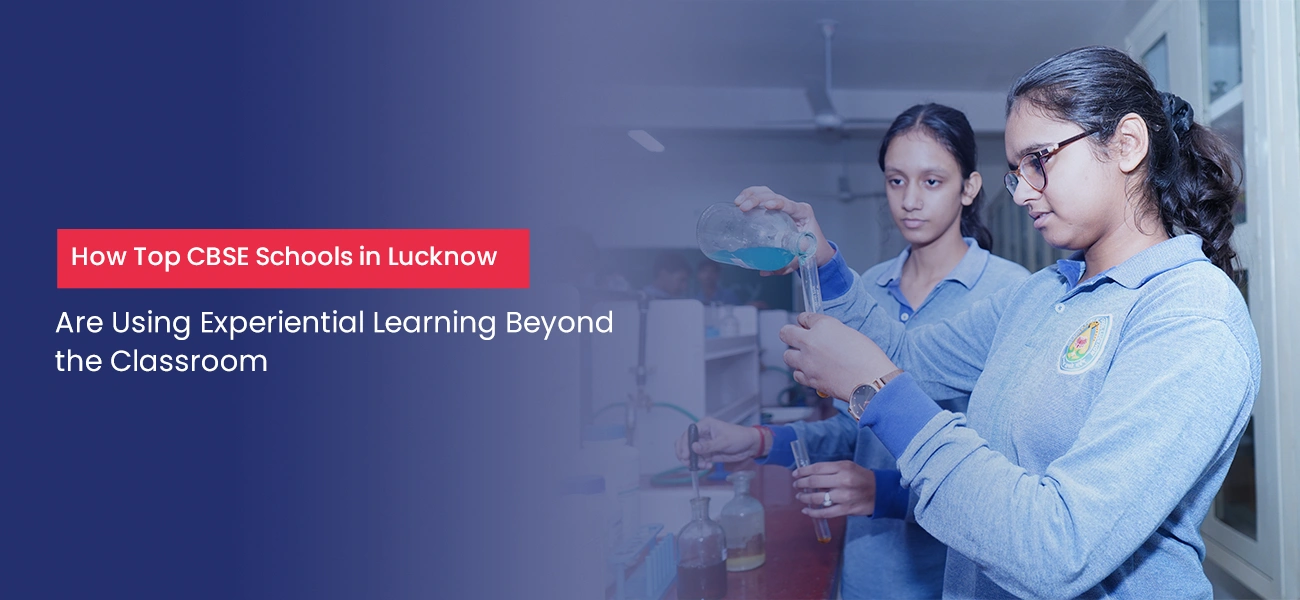
Learning is not a spectator sport. If you sit in a classroom and listen to someone talk about the physics of a pendulum for an hour, you might remember the formula. You might even pass the test. But do you actually feel the gravity? Do you understand the tension in the string? Probably not. This is exactly where the narrative is shifting in the City of Nawabs. Using hands-on activities and experiential learning, schools are moving away from the traditional "chalk and talk" method toward something far more visceral.
Lucknow Public School, one of the best CBSE schools in Ansal API, is at the helm of this change. We believe that the four walls of a classroom should be porous. Information should flow in from the real world, and students should step out to meet it. This isn't just about "activity-based learning", which has become a bit of a tired buzzword in academic circles. No, we are talking about experiential learning, a process where knowledge is created through the transformation of experience.
The Shift from Rote to Real
Why does this matter right now? Because the world is changing at a breakneck speed. Statistics show that nearly 65% of children entering primary school today will end up working in completely new job types that don’t even exist yet. How do you prepare a child for a job that hasn't been invented? You don't do it by making them memorise dates. You do it by teaching them how to think, adapt, and solve problems in real-time.
In the context of CBSE schools in Ansal API, the competition is stiff, but the focus is often misplaced. Many institutions still prioritise the "gold medal" in board exams over the "gold standard" of life skills. At LPS, we’ve decided to break that mould. We look at the Ansal API township not just as a location but as a living laboratory.
Think about biology. Instead of looking at a grainy diagram of a leaf in a textbook, our students are out in the green belts of the city. They are identifying species. They are measuring soil pH levels. They are seeing the impact of urban heat islands firsthand. It’s messy. It’s loud. It’s unpredictable. And it is, quite frankly, the only way to truly learn.
The Architecture of Experience
What does this look like on a Tuesday morning? It looks like a group of middle-schoolers running a mock parliament to understand civics. It looks like high school students are visiting local manufacturing units to see how supply chain management actually functions. Have you ever wondered why we expect kids to understand the complexities of the Indian economy by reading three paragraphs in a social studies book? It's absurd.
We take them to the markets. We let them interview vendors. We ask them to calculate the profit margins of a street-side stall versus a high-end retail outlet. This is where the magic happens. When a student realises that the maths they learnt in grade 6 is the same maths used to run a business, their eyes light up. That "Aha!" moment is the holy grail of education.
Why Ansal API is the New Hub for Excellence
Location matters more than people think. Searching for good schools in Ansal API usually leads parents to a list of fancy buildings and swimming pools. While infrastructure is great, the soul of a school lies in its pedagogical philosophy. The Ansal API area provides a unique ecosystem. It’s a blend of modern urban planning and developing communities. This provides a rich tapestry for social projects.
Our students participate in community outreach programmes right here in the neighbourhood. They aren't just "volunteering" for a certificate. They are designing waste management systems for local clusters. They are teaching basic literacy to the children of construction workers. They are learning empathy, which, by the way, is a skill that AI cannot replicate. Recent data suggests that "soft skills" like empathy and emotional intelligence are now the most sought-after traits by Fortune 500 recruiters.
The Science Behind the "Doing"
Let’s get nerdy for a second. The brain is a pattern-seeking organ. According to Edgar Dale’s Cone of Experience, people generally remember 10% of what they read but 90% of what they do as a real effect. If we want our kids to be the leaders of tomorrow, why are we feeding them the 10% diet?
At Lucknow Public School, our laboratories are not just for chemistry experiments. They are innovation hubs. We integrate STEAM (science, technology, engineering, arts, and mathematics) in a way that feels natural. A student might use a 3D printer to create a model of a historical monument. This isn't just a history lesson; it's a lesson in spatial awareness, technology, and art.
Breaking the Monotony
School shouldn't be a grind. It shouldn't be a place where curiosity goes to die. Yet, for many, it is. The standard school day is a series of bells and transitions that segment knowledge into artificial boxes. "Now it's time for geography." "Now it's time for maths," but the world isn't segmented.
We encourage interdisciplinary projects. If a student is interested in the history of Lucknow's architecture, they explore the Mughal influence (history), the structural integrity of the domes (physics), and the poetic inscriptions on the walls (literature). This holistic approach is what sets the best CBSE schools in Ansal API apart from the rest. We aren't just teaching subjects; we are teaching the interconnectedness of everything.
The Role of Technology
Don't get it twisted; experiential learning isn't "anti-tech". It’s "tech-smart". We use virtual reality (VR) to take students to the Great Barrier Reef or the surface of Mars without leaving the room. But we don't stop there. We ask them: "Now that you've seen the coral bleaching, how would you fix it? "The technology is the spark, but the experience—the debate, the research, the prototyping—is the fuel.
Data from the World Economic Forum indicates that critical thinking and complex problem-solving are the top two skills required in the modern workforce. You don't develop these by clicking on a multiple-choice answer. You develop them by facing a problem that doesn't have a clear answer. By failing. By trying again. By collaborating with a teammate who has a different opinion.
Is it harder? Yes. Is it better? Absolutely.
It’s much easier to sit kids in rows and tell them to be quiet. It’s much easier for a teacher to read from a PowerPoint. Experiential learning is chaotic. It requires more planning, more resources, and a lot more energy from the faculty. But look at the results. Students who learn this way are more engaged. They have higher retention rates. They are more confident.
We often see parents worried about "covering the syllabus"; it's a valid concern. But here’s a secret: when a student is genuinely interested in a topic because they’ve experienced it, they blaze through the syllabus. They don't need to be pushed; they are pulled by their own curiosity.
A Culture of Inquiry
We want our students to be the ones asking "Why?" and "How?" rather than "Is this coming in the exam?" That shift in mindset is the greatest gift we can give them. Whether it’s through field trips, internships, project-based learning, or community service, the goal is to make education a living, breathing thing.
Lucknow is a city of tradition, but it is also a city of the future. By blending the rigor of the CBSE curriculum with the dynamism of experiential learning, we are creating a new blueprint for success. It’s about balance. It’s about knowing the theory but also knowing how to apply it when the stakes are real.
So, if you’re looking at the landscape of education in our city, don't just look at the board results. Look at the children. Are they excited to go to school? Are they talking about what they did today, or just what they heard? The future belongs to the doers.

Written by:Vivek