blog detail
- Home
- blog detail
 July 25, 2026
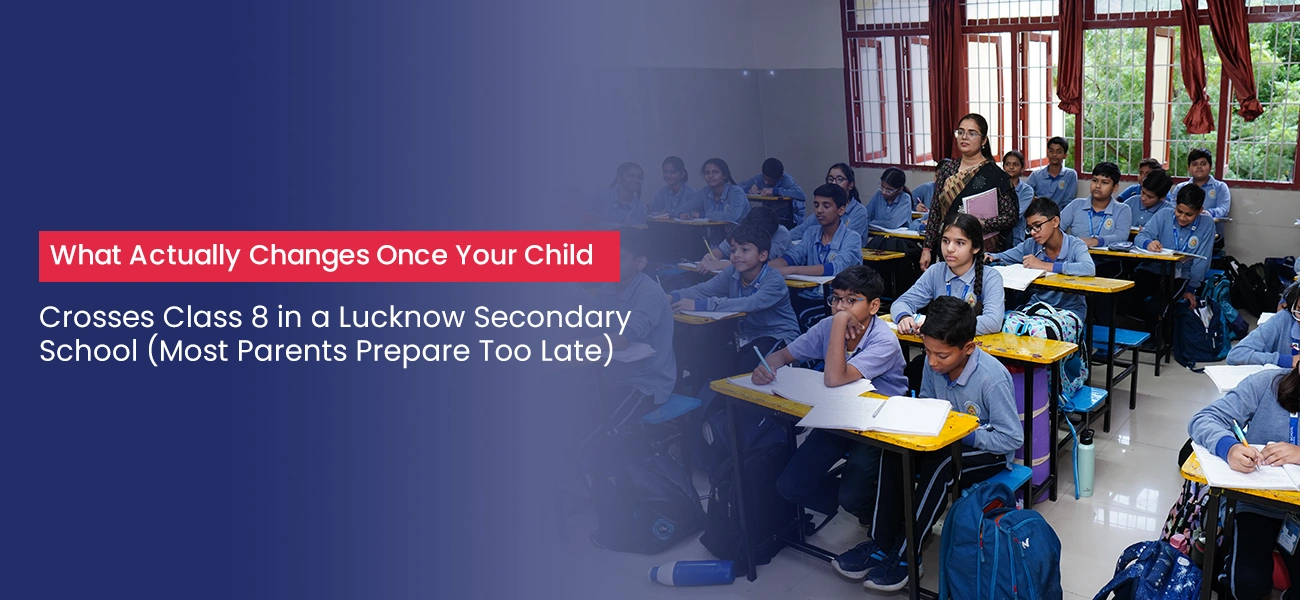
What Actually Changes Once Your Child Crosses Class 8 in a Lucknow Secondary School (Most Parents Prepare Too Late)
There is a particular kind of quiet that settles over a home when a child moves from Class 8 into Class 9. The school bag looks the same. The uniform still fits. The morning rush is unchanged. And yet, almost invisibly, the rules of the game have shifted. Most parents in Lucknow notice this only around the middle of Class 9, when the first proper test paper comes home with a number on it that nobody expected. By then, the adjustment window has already begun to close.
This is where most of the top secondary school in Lucknow rarely explain. So let us walk through what genuinely changes, why it catches families off guard, and what preparing early actually looks like.
The safety net quietly disappears
For years, your child moved up each grade almost automatically. That was not luck. It was policy. Section 16 of the Right to Education Act, 2009 barred schools from holding back any student up to Class 8. In January 2019, Parliament amended that provision, and in December 2024 the Centre notified rules allowing schools to detain students in Classes 5 and 8 who fail to clear their year-end exams. The reason, stated plainly by education officials, was that automatic promotion left children unprepared for board exams and pushed up failure rates in Class 10.
Read that last line again. The system itself now admits that the years before Class 9 were softer than the years after. Once your child crosses Class 8, the cushioning is gone. Performance starts to carry consequences, and it does so quickly.
The syllabus stops being forgiving
Class 9 is where the CBSE curriculum changes character. Concepts that were introduced gently in middle school are now taught for retention, application, and examination. Mathematics moves from arithmetic comfort into algebra and geometry that demand daily practice. Science begins to split into Physics, Chemistry, and Biology reasoning, even within one combined subject. Social Science expects source-based thinking, not memorised answers.
There is also a structural change many parents miss. In CBSE Class 10, the final grade is built from an 80-mark board examination and 20 marks of internal assessment gathered across the year. In other words, marks are being quietly collected long before board exam week. A child who treats Class 9 as a rest year is often already behind when Class 10 begins.
Marks begin to follow your child around
Here is the uncomfortable truth. Class 9 and Class 10 are no longer just school years. They become a track record. The confidence a child builds, or loses, in these two years shapes which stream feels possible in Class 11, which in turn shapes college and career options.
When CBSE declared its Class 10 results on 13 May 2025, the overall pass percentage was 93.66%, a small rise over 93.60% the previous year. That headline sounds reassuring. What it hides is the wide gap between simply passing and reaching the 90-plus band that competitive streams quietly expect. Uttar Pradesh, in fact, recorded the highest number of Class 10 passes in the country that year, with 4,00,963 students clearing the exam. Your child is entering a crowded and highly capable field.
The emotional shift nobody warns you about
This is the change that rarely appears on any syllabus. Around Class 9, children begin to feel the weight of expectation, sometimes for the first time. Homework turns into self-directed study. A teacher can no longer walk every student through every single step. The ones who adapt are usually the ones who learned, earlier, how to sit with a hard problem without giving up.
This is exactly where families prepare too late. They wait for marks to fall before they act. A better approach is to build study habits, curiosity, and emotional steadiness while the stakes are still low, so the child meets Class 9 already fluent in the skill of learning on their own.
Why the school you choose now matters more than before
Up to Class 8, almost any decent school in Lucknow can carry a child along. Secondary school is where the differences between institutions start to show. The gap between an average option and a top secondary school in Lucknow becomes visible in exactly these years. A strong secondary school in Lucknow does three things at once: it keeps academic rigour high, it catches struggling students before they slip, and it protects a child's confidence through the pressure.
This is where the LPS has built its reputation. Lucknow Public School was founded in 1988 under the vision of Late Shri C.P. Singh, and has since grown into a network of 10 branches across Uttar Pradesh serving more than 14,000 students, with top Class 10 and Class 12 scores reaching 98.8 percent. Its teaching philosophy rests on three ideas working together: Vidya, which is modern education; Sadvidya, which is values and discipline; and Brahmavidya, which is awareness and character. For a child entering the demanding secondary years, that blend of rigour and grounding is not a luxury. It is the difference between surviving Class 9 and thriving through it.
What preparing early actually looks like
Preparation is not about buying more guidebooks. It is quieter and more practical. Talk to your child about effort, not only marks. Protect one fixed, distraction-free study hour before Class 9 even begins. Watch for subjects where confidence is thinning, and address them early. And choose a secondary school environment that will push and support your child in equal measure. Families who do this rarely describe Class 9 as a shock. They describe it as the year their child grew up.
The Takeaway
The transition after Class 8 is real, and it is faster than it looks. The parents who prepare early are not the anxious ones. They are simply the ones who saw the shift coming. If your child is approaching this stage, the time to build the right habits and to choose the right secondary school in Lucknow, like Lucknow Public School, is now, not in the middle of Class 9.

Written by:Vivek