blog detail
- Home
- blog detail
 July 18, 2026
How Smart Classrooms Are Changing the Way Children Learn in Lucknow's Top Schools?
Remember the dusty chalkboards and the frantic scribbling of notes before the teacher wiped the slate clean? For many of us, that was the "gold standard" of education. But walk into any of the top schools in Lucknow today, and you’ll realise that world is gone. The heavy scent of chalk has been replaced by the quiet hum of interactive panels and high-speed fibre optics.
We are seeing a fundamental shift in how children process information. It’s no longer about who has the best handwriting or who can memorise the most dates. It’s about who can navigate information, visualise abstract concepts, and solve problems in real time. This isn’t just a feature anymore; in the best CBSE schools in Lucknow, smart technology has become the central nervous system of the learning process, changing the way students learn, think, and prepare for the future.
Why "Passive Learning" is Failing the Modern Student
For years, schooling was a one-way street: the teacher spoke, and the student listened. But cognitive psychology tells us that the human brain, especially a developing one, retains only about 10% of what it reads but nearly 90% of what it simulates or experiences.
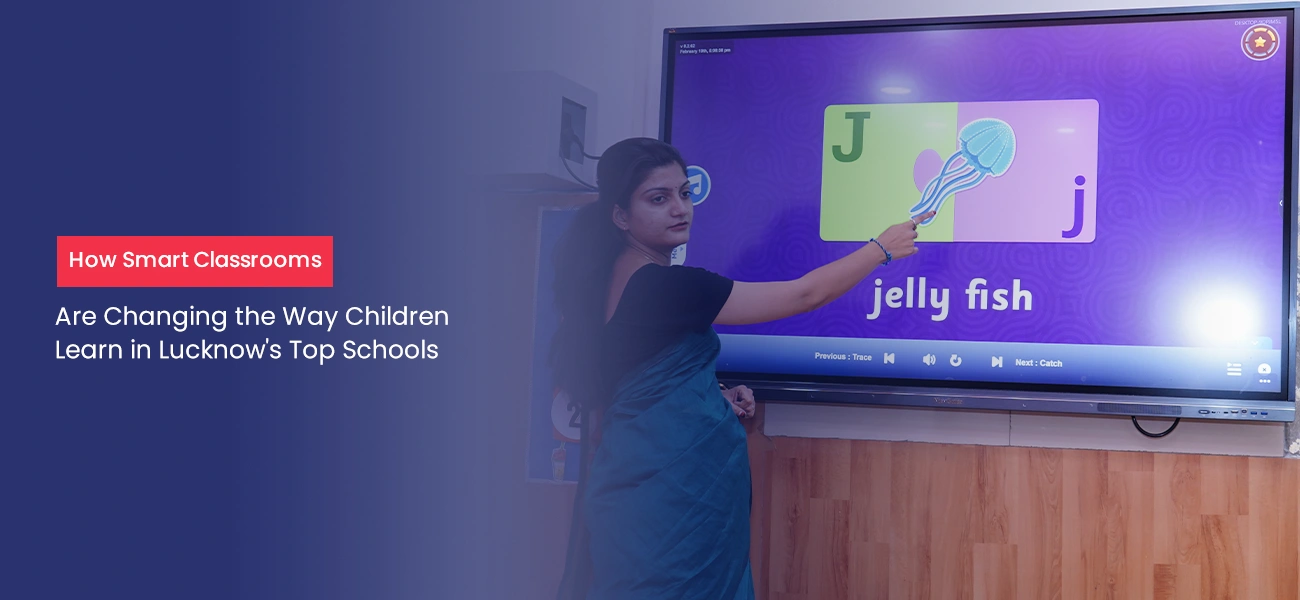
This is where traditional schools in Lucknow often hit a wall. You can describe the rings of Saturn for an hour, or you can use a 4K interactive display to let a sixth-grader "fly" through them. The difference in retention isn't just significant; it’s transformative. At LPS Lucknow, we’ve observed that when students engage with touch-sensitive technology and 3D modules, the "boredom gap" virtually disappears.
The Anatomy of a Smart Classroom: As Experienced in the Top Schools in Lucknow
There’s a common misconception that putting a screen in a room makes it a "smart classroom". In reality, a truly tech-integrated environment at LPS Lucknow involves three critical layers:
1. The Visual Layer (AR & 3D Modeling)
Abstract subjects like chemistry or geometry are the traditional "nightmares" for students. Smart classrooms change this by turning a 2D diagram of a molecular bond into a 3D object that can be rotated and dissected.
2. The Collaborative Layer (Cloud-Based Feedback)
The quietest student in the back of the room often has the best ideas but fears speaking up. Modern smart systems allow for real-time, anonymous polling and collaborative digital whiteboards. This ensures that every voice is heard, creating a more inclusive psychological environment.
3. The Analytical Layer (AI-Driven Progress Tracking)
This is the "invisible" side of smart tech. Modern systems help educators identify precisely where a class is struggling. If 70% of the class fails to grasp a specific algebraic concept during an interactive quiz, the teacher knows instantly, not three weeks later during a mid-term exam.
The Lucknow Market: Why Parents are Choosing Tech-Enabled Schools
If you look at the current educational landscape, the demand for top schools in Lucknow is heavily driven by "future-proofing". Parents are savvy. They know that by 2030, digital literacy won't be a skill—it will be a prerequisite for survival.
Many of the best CBSE schools in Lucknow are still struggling with "tech fatigue"—where expensive equipment sits unused because teachers weren't trained. At LPS Lucknow, our approach has been different. We focus on "hybrid pedagogy". We don't replace the teacher with a screen; we arm the teacher with a superpower.
Behavioral Insights: How Tech Impacts Student Psychology
One fascinating observation from our classrooms is the shift in "trial and error" behaviour. In a traditional notebook, a mistake is messy; it requires an eraser or a strike-through. This often makes children "risk-averse".
In a digital environment, the "Undo" button is a safety net. Students are more willing to experiment, to try a different formula, or to build a different structure in a virtual physics lab. This builds a growth mindset, teaching them that failure is just a data point on the way to a solution.
Conclusion: The New Heritage of Lucknow’s Education
Lucknow has always been a city that values its heritage and its "tehzeeb". But true heritage is about passing on the best possible future to the next generation. We cannot prepare children for a 21st-century world using 19th-century methods.
The transition to smart classrooms among the top schools in Lucknow is not a trend; it is an evolution. By choosing a school like LPS Lucknow, you aren't just giving your child a seat in a classroom—you're giving them a ticket to a world where they can visualise the invisible and achieve the impossible.
Ready to see the future of learning?
[Visit our LPS Lucknow campus] and witness how we’re turning the "standard" classroom into a hub of digital discovery.

Written by:Vivek