blog detail
- Home
- blog detail
 July 24, 2026
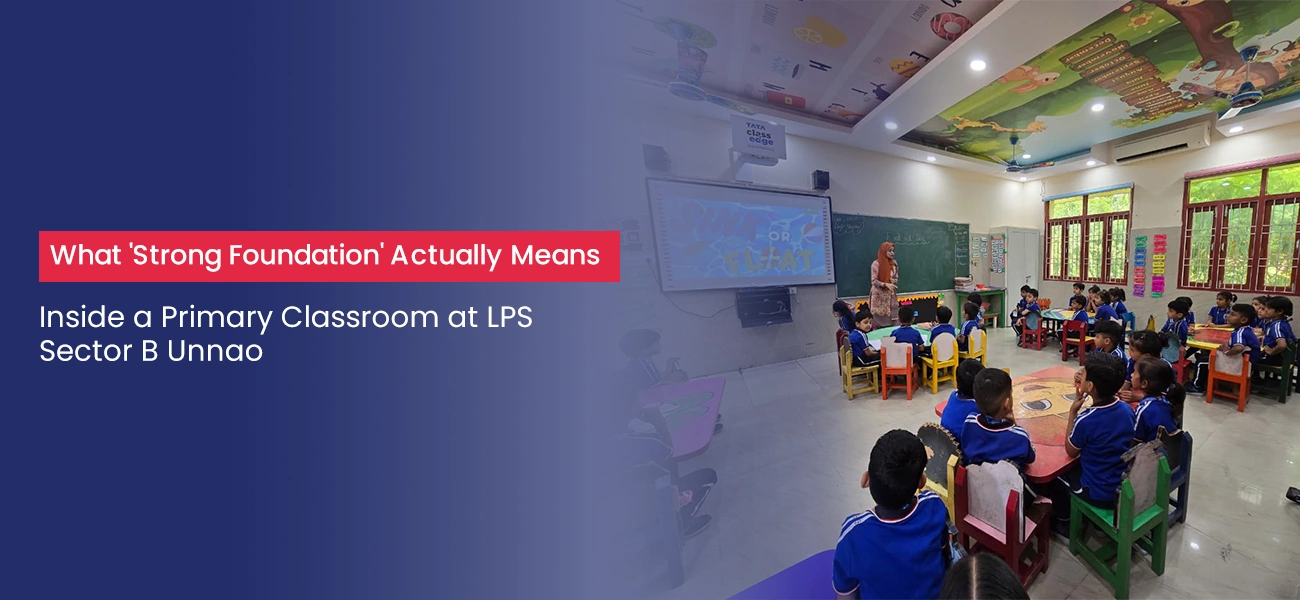
What 'Strong Foundation' Actually Means: Inside a Primary Classroom at LPS Sector B Unnao
Every parent hears the phrase. Brochures print it, admission counsellors repeat it, and hoardings across town promise it. But what does a strong foundation actually look like when you walk past the door of a Grade 2 classroom at eight forty in the morning? At LPS, a leading primary school in Sector B Unnao, the answer is far less dramatic than the marketing suggests and far more meaningful. It looks like a child confidently raising a hand to say she does not understand. It looks like a teacher pausing a lesson because three students are still stuck on the previous idea. Foundation is not a slogan here. It is a daily practice.
The First Ten Minutes Tell You Everything
Visit any classroom before the lesson formally begins and you learn more than any prospectus can offer.
- Children greet the teacher by name, not by rank
- Bags are unpacked without being told twice
- The blackboard already carries yesterday's unfinished question
- Nobody is punished for arriving with a doubt
These small things are deliberate. Routine builds security, and security is the precondition for learning. A child who feels safe asks better questions.
Learning That Moves at the Child's Pace
The most common mistake in early education is confusing speed with strength. A student who memorises multiplication tables in Grade 1 may still struggle to understand what multiplication means in Grade 5.
Teachers at LPS are trained to notice the difference. Concept mastery is checked through application, not recitation. A number is not just a symbol to be written neatly. It is a quantity a child can picture, count out with beads, and explain to a classmate.
This is one of the quiet reasons LPS is regularly counted among the top ten schools in Sector B Unnao by families who have watched their children move through the primary years and into higher grades without the usual gaps appearing.
Teachers Who Know Every Child by Name and by Need
Class strength is deliberately managed so that no student becomes invisible. Each teacher maintains observation notes covering:
- Reading fluency and comprehension progress
- Confidence during group participation
- Handwriting and motor coordination development
- Emotional patterns such as withdrawal or frustration
- Peer relationships and collaborative behaviour
These notes are reviewed monthly with the academic coordinator. Parents are not handed a report card and left to interpret it alone. They are told what was noticed, what was tried, and what comes next.
Why Foundation Cannot Be Rushed
There is a temptation among best cbse schools in unnao to demonstrate results early, because early results are visible and comforting. LPS resists this. The primary years are treated as a slow build, not a showcase.
A few principles guide this approach:
- Phonics before speed reading
- Number sense before formula drilling
- Expression before examination technique
- Curiosity before competition
Parents sometimes ask why their child is not solving harder sums yet. The honest answer is that the child is still building the mental architecture that makes harder sums easy later. That architecture cannot be hurried without cracking.
The Role of Play, and Why It Is Not a Break From Learning
Physical activity, art, music, and free play are timetabled with the same seriousness as language and mathematics. Research in early childhood development consistently links unstructured play to improvements in problem solving, negotiation, and emotional regulation.
At LPS, a games period is not a reward for finishing syllabus. It is part of the syllabus.
What Parents Actually Notice at Home
Parents rarely describe academic progress first. When asked what changed after joining, most mention behaviour.
- The child begins explaining things without being asked
- Homework arguments reduce because the child understands the task
- Questions at the dinner table become sharper
- There is less fear around tests and more interest in the subject
Among schools in Sector B Unnao, this shift in home behaviour is often the clearest evidence that the foundation is holding.
A Thought Worth Keeping
"Education is the most powerful weapon which you can use to change the world." Nelson Mandela, speech at the University of the Witwatersrand, Johannesburg, 2003
Mandela was not describing degrees or scores. He meant the capacity education builds inside a person. A primary classroom is where that capacity begins, which is exactly the philosophy visible in the everyday practice at LPS.
Choosing Well, Not Quickly
Selecting a school is one of the few decisions parents cannot easily reverse. Before finalising any option, it helps to:
- Visit during working hours, not on an open day
- Watch how teachers speak to children who are struggling
- Ask what happens when a child falls behind
- Check whether communication with parents is structured or occasional
Families researching a primary school in Sector B Unnao are encouraged to visit LPS and observe an ordinary working morning. More details are available at thelpsedu.co.in.
A strong foundation is not something a school can prove in a brochure. It is something you notice in how a seven year old behaves when nobody is watching.

Written by:Vivek