blog detail
- Home
- blog detail
 May 25, 2026
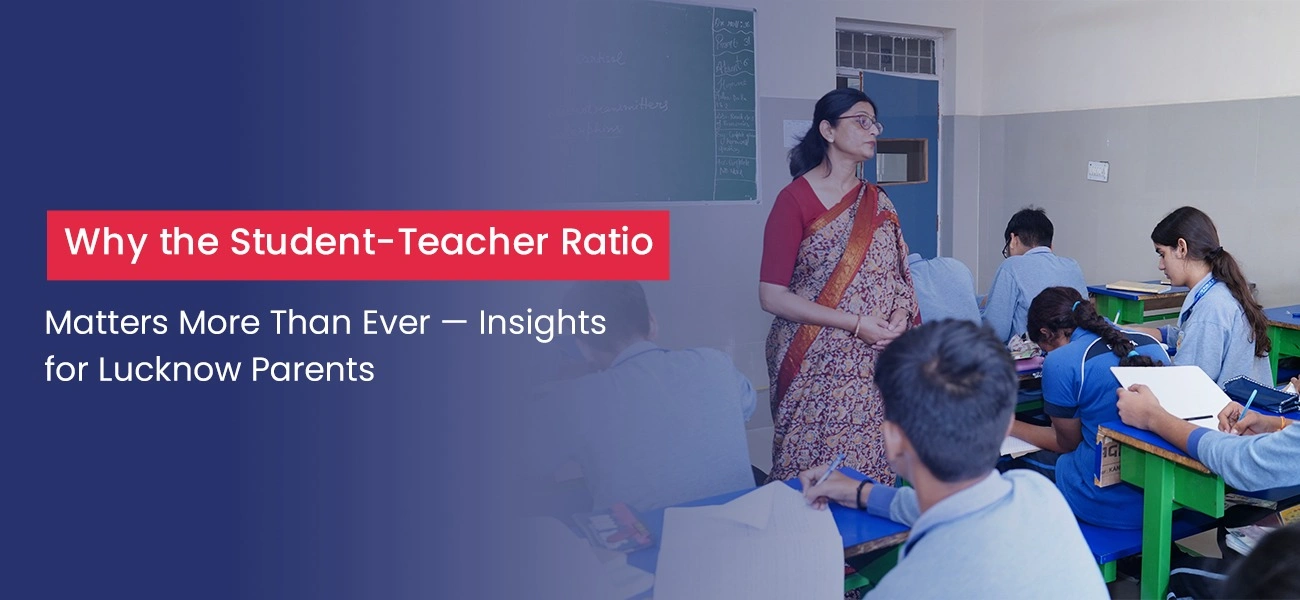
Why the Student-Teacher Ratio Matters More Than Ever: Insights for Lucknow Parents
Choosing a school used to feel simpler.
A decent campus. Good marks. Safe transport. Done.
Not anymore.
Today, parents in Lucknow are asking sharper questions. They want to know who is teaching their child. They want to understand whether their son feels seen in class or whether their daughter is quietly disappearing in a crowd of sixty students. Fair questions, honestly. Childhood moves fast, and learning gaps appear even faster.
That is exactly why the student-teacher ratio has become one of the biggest indicators of educational quality across the good schools in Lucknow conversations.
And no, this is not just another statistic schools throw around during admissions.
It changes everything.
What Does Student-Teacher Ratio Actually Mean for Your Child?
Most parents hear the term and immediately think numbers.
Thirty students. One teacher.
Forty students. One teacher.
Simple math, right?
Not quite.
A healthy student-teacher ratio determines how much personal attention your child receives every single day. These insights highlight how it influences classroom discipline, emotional confidence, academic growth, communication skills, participation levels, and even whether a child enjoys going to school in the first place.
Children are not machines. They cannot all learn at the same pace.
Some raise their hands instantly. Others stay silent even when they desperately need help. Some absorb concepts visually. Others need repetition, storytelling, diagrams, patience, reassurance, and sometimes just one teacher who notices they are struggling before report cards reveal it.
That noticing matters.
At LPS Lucknow, classrooms are designed around interaction, not overcrowding. Teachers are trained to identify individual learning patterns instead of teaching to the middle of the room and hoping everyone catches up somehow.
That difference becomes visible very quickly.
Big Classrooms Often Hide Small Problems
Here is something many parents discover too late.
A child can score “average” for years while silently losing confidence.
Why? Because crowded classrooms make it easy for students to disappear.
The quieter child gets overlooked. The hesitant reader avoids participation. The student facing anxiety becomes “well-behaved” simply because nobody notices they stopped engaging altogether.
And once that disconnect starts, rebuilding confidence becomes harder every year.
This is why many families searching for good schools in Lucknow are no longer impressed only by infrastructure photos or board percentages. They are looking deeper. They want schools where teachers know names, personalities, strengths, fears, and learning styles.
Frankly, they should.
Teachers at Lucknow Public School collaborate with students beyond textbooks. Teachers regularly check participation, behavioural change, emotional health, patterns of work, and interactions with peers.
Parents notice that.
Students feel it even more.
Why Individual Attention Is the Real Academic Advantage
Every parent wants good marks. Naturally.
But marks are usually outcomes. Not the process.
The real process happens quietly inside classrooms every day through conversations, corrections, encouragement, and small moments of guidance that shape a child’s confidence over time.
Think about it.
When a teacher has enough bandwidth to individually engage students, children ask more questions. They participate more freely. Doubts get resolved immediately instead of piling up chapter after chapter until exams arrive like a storm.
Suddenly, learning stops feeling stressful.
At LPS Lucknow, teachers are encouraged to mentor, not merely instruct. That distinction changes classroom culture completely. Students are not treated as roll numbers moving through a syllabus pipeline. Teachers actively monitor progress and adapt methods according to individual student needs.
Some students need motivation.
Some need structure.
Some simply need someone patient enough to explain one concept three different ways.
Good schools understand this reality deeply. Great schools build systems around it.
Parents Need Communication, Not Just Report Cards
Let us be honest.
Many schools communicate with parents only when something goes wrong.
Low marks. Poor attendance. Behavioural issue.
That approach feels outdated now.
Modern parenting is collaborative. Parents want regular insight into how their child is evolving emotionally, socially, and academically. They want teachers who respond thoughtfully instead of mechanically forwarding circulars.
And honestly, children perform better when schools and families work together instead of operating like separate worlds.
One reason many parents consider LPS Lucknow among the top schools in Lucknow is the school’s emphasis on active parent-teacher engagement. Teachers maintain consistent communication regarding classroom behaviour, performance trends, participation levels, and developmental observations.
Sometimes, a five-minute conversation between a parent and teacher prevents months of academic struggle later.
That partnership matters enormously.
The Human Side of Teaching Still Wins
Technology is everywhere now.
Smart boards. AI tools. Learning apps. Recorded lectures.
Useful? Absolutely.
Enough on their own? Not even close.
Children still need a human connection to learn effectively. They need encouragement after failure. They need teachers who notice when they look distracted. They need someone who celebrates improvement even when the marks are not perfect yet.
That emotional layer cannot be automated.
In Lucknow Public School, teachers are trained not just on teaching the curriculum but also in teaching children, their psychology, communication strategies, and engagement techniques. Teachers establish safe spaces for students to speak, ask questions, engage, and at times fail without fear.
Because growth requires safety.
And emotionally secure children learn faster.
Simple truth.
Smaller Ratios Create Stronger Leadership Skills
Academic performance is important. Of course.
But school life is also where children learn confidence, leadership, teamwork, and expression. In crowded classrooms, it is only the loudest students who typically lead the discussions, competitions, and opportunities for participation.
The rest watch quietly.
Healthy student-teacher ratios change that dynamic.
Teachers can plan ways to engage quieter students in collaborative projects, presentations, activities, and debates. Once children avoid public speaking, they gradually learn to voice their opinions with confidence.
Those shifts shape adulthood more than many exams ever will.
Parents exploring good schools in Lucknow increasingly understand that education is no longer only about memorisation. Communication, confidence, adaptability, and emotional intelligence matter deeply in today’s world.
Schools must nurture all of it.
LPS Lucknow focuses on holistic development by ensuring students receive adequate guidance inside and outside classrooms, helping every child discover strengths that traditional academics alone may never reveal.
Discipline Improves Naturally When Students Feel Seen
Interesting thing about children.
They respond differently when they know adults genuinely notice them.
In schools with overwhelming classroom sizes, discipline often depends on strict rules and constant correction because teachers simply cannot individually monitor every child effectively.
But in more balanced classrooms, discipline becomes relationship-driven.
Students engage more. Teachers intervene earlier. Behavioural patterns get identified before becoming larger issues. Children also feel more accountable because they know their teachers actually know them personally.
That creates healthier classrooms.
At LPS Lucknow, classroom management focuses on positive engagement rather than intimidation. Teachers maintain structured yet approachable environments where students feel respected while understanding boundaries clearly.
Parents appreciate that balance enormously.
Choosing a School Is Choosing an Environment
This decision is bigger than admissions.
Bigger than brochures, too.
The school environment your child enters every morning shapes confidence, friendships, curiosity, emotional security, communication habits, and learning attitudes for years.
That is why the student-teacher ratio deserves serious attention during school selection.
Ask schools difficult questions.
- How many students are there per class?
- How often do teachers interact individually with children?
- How does the school support struggling learners?
- How accessible are teachers to parents?
The answers reveal far more than glossy marketing campaigns ever will.
Many families searching for the best school in Lucknow eventually realise one simple truth: children thrive where they feel recognised, guided, supported, and encouraged consistently.
That is the environment schools should strive to create.
And that is exactly what Lucknow Public School continues building through dedicated educators, balanced classrooms, personalised mentoring, and a deeply student-centric philosophy.

Written by:Vivek