blog detail
- Home
- blog detail
 July 28, 2026
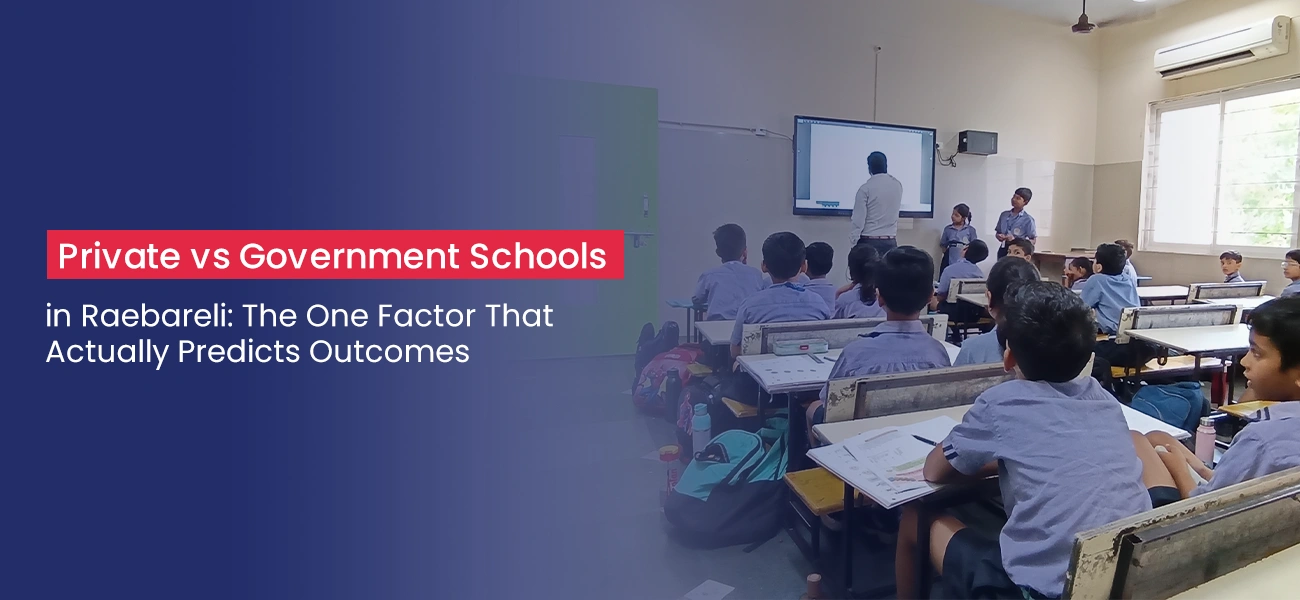
Private vs Government Schools in Raebareli: The One Factor That Actually Predicts Outcomes
Every year, thousands of parents across Uttar Pradesh sit down with the same question. Should the child go to a government school or should the family stretch its budget for a private school in Raebareli? The debate usually gets stuck on fees, uniforms, and English medium instruction. But after speaking to parents, teachers, and school heads across the district, one pattern keeps showing up, and it has very little to do with the board written on the gate.
The Comparison Everyone Makes First
Most families start by comparing the obvious things:
- Fee structure. Government schools cost almost nothing. Private schools ask for annual fees, transport, and books.
- Infrastructure. Smart classrooms and laboratories versus older buildings that were built decades ago.
- Medium of instruction. English medium is often the single biggest reason parents shift their children.
- Class strength. A section of 30 behaves very differently from a section of 65.
These points are real. They matter. But they are not what separates a student who clears NEET from one who drops out after Class 12.
The Factor That Actually Predicts Outcomes
The single strongest predictor is teacher contact time per student, and more specifically, whether that contact is consistent across the full academic year.
Not the fee. Not the building. Not even the board.
Consider what this looks like in practice. A government school teacher in Raebareli may be genuinely excellent, often with better formal qualifications than a private counterpart, but is frequently pulled into election duty, census work, and midday meal administration. A private school teacher may have thinner credentials on paper but is present in that classroom every working day, tracking the same 30 children through the syllabus.
Research from ASER and the Annual Status of Education Report has repeatedly shown the same thing across Indian districts. Learning outcomes track instructional time far more closely than they track infrastructure spending. A child who receives 180 uninterrupted teaching days will outperform a child who receives 120, regardless of how impressive the campus looks in the brochure.
This is why two schools with identical fee structures can produce completely different results.
How to Actually Judge a School
Here is what experienced parents check when they visit a campus and what most first-time visitors miss:
- Ask about teacher retention, not teacher qualification. If half the staff changed last year, the syllabus continuity broke.
- Ask how many working days the school completed last session. A confident school will have the number ready.
- Ask what happens when a teacher is absent. Substitution policy tells you more than the science lab does.
- Ask to see a corrected notebook from the middle of the term, not the first week.
- Ask how parents are informed when a child starts falling behind. Silence until the report card is a warning sign.
Watch how the answers come. Hesitation on these questions usually means the school has never measured them.
Where This Leaves Parents in the Region
The practical conclusion is uncomfortable for both sides of the debate. Choosing a private school in Raebareli does not automatically buy better outcomes. It buys the possibility of consistent contact time, but only if the institution is actually managed for it.
This is where structured institutions have an advantage. Schools operating under established academic frameworks tend to protect instructional days because their internal assessment calendars depend on it. Families comparing options in the wider region often extend their search toward the best CBSE schools in Sector B, Unnao, where the CBSE structure enforces a fixed academic calendar and continuous evaluation cycle. best school in raebareli cbse board is one such institution where the CBSE framework anchors the teaching year, and parents can review its academic approach directly at thelpsedu.co.in.
The point is not geography. It is that a well-governed school in any town beats a poorly governed one in a bigger city.
A Word Worth Remembering
"Education is the most powerful weapon which you can use to change the world." — Nelson Mandela, speech at the launch of Mindset Network, Planetarium, University of the Witwatersrand, Johannesburg, 16 July 2003
What it means here: Mandela stresses education as the instrument, not the institution. A weapon only works if it is used consistently. That is exactly the contact time argument, applied to a child's twelve school years.
What Parents Should Do This Admission Season
If you are deciding right now, work through this in order:
- Shortlist on distance first. A 90-minute commute quietly destroys study hours and health.
- Verify board affiliation directly on the CBSE or UP Board portal, not from the prospectus.
- Visit on a normal working Tuesday, never on an open house day.
- Speak to two current parents whose children are one year senior to yours.
- Decide last on fees. The cheapest school that teaches 180 days beats the costliest one that teaches 130.
The Honest Conclusion
Government schools in Raebareli are not failing because of poor teachers. Private schools are not succeeding because of air-conditioned classrooms. The gap is administrative continuity, and it is measurable if you ask the right questions.
A serious private school in Raebareli earns its fee by protecting teaching time. One that does not is simply a more expensive version of the problem. Families widening their search to institutions like best school in raebareli cbse board, or comparing the best CBSE schools in Sector B, Unnao, are doing the right thing by evaluating the academic system rather than the marketing.
Ask about days taught. Everything else follows.

Written by:Vivek