blog detail
- Home
- blog detail
 July 23, 2026
What 'Smart Classes' Actually Means at a Modern School in Lucknow (And How to Tell If a School Is Bluffing)
Walk into any admission office today and you will hear the phrase within the first two minutes. Smart classes. It has become the default selling point for almost every modern school in Lucknow, printed on brochures and repeated in every parent counselling session. But here is the uncomfortable truth: a projector mounted on a wall is not a smart class. A television playing a downloaded video is not one either.
So what is it actually? And how do you walk into a campus and figure out within twenty minutes whether a school is genuinely teaching differently or simply decorating an ordinary classroom with expensive hardware?
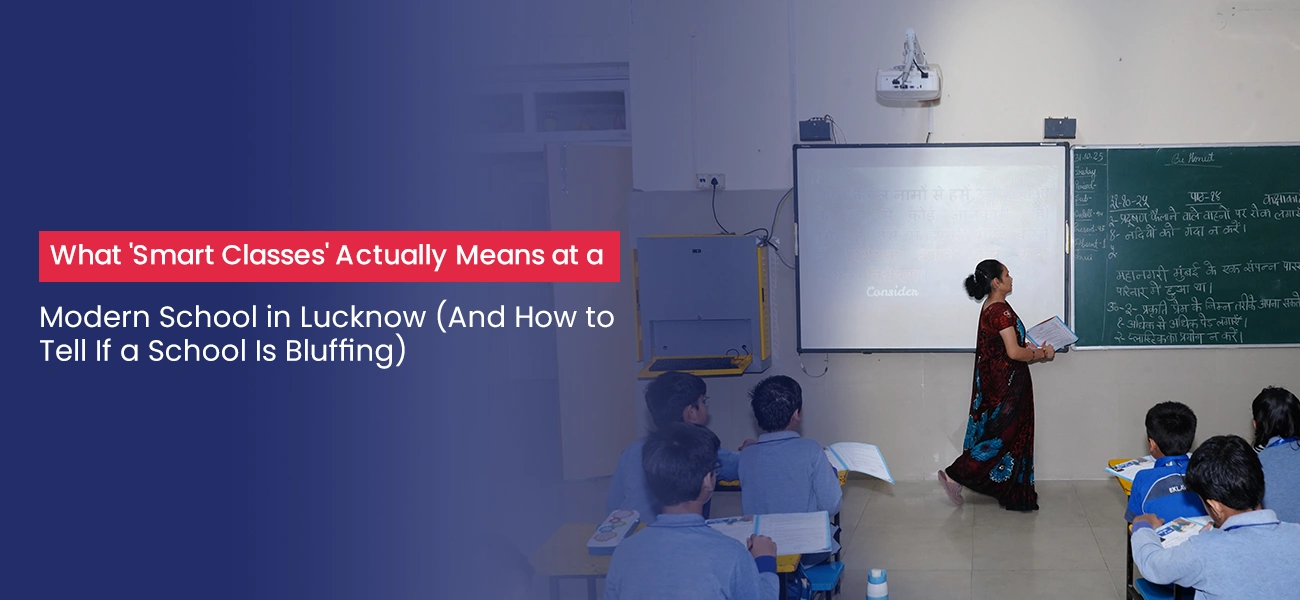
What a Smart Class Genuinely Looks Like
A real smart classroom is not defined by equipment. It is defined by what changes in the room because of that equipment.
- The teacher still teaches. Technology supports the lesson, it does not replace the person standing before thirty children.
- Content is mapped to the syllabus, not pulled randomly from the internet the previous night.
- Students touch the board too. If only the teacher operates the panel, it is a presentation.
- Assessment happens live. Quick polls, instant quizzes, gaps addressed within the same period.
- Abstract concepts become visual. A rotating 3D heart teaches more in forty seconds than four blackboard diagrams.
That last point holds the real value. Children in classes six to ten struggle most with what they cannot see: molecular structures, planetary motion, historical timelines. Good digital teaching solves exactly this and nothing more.
The Bluff: Six Questions That Expose Everything
Parents are often too polite during school visits. Do not be. You are making a decision worth several lakhs across a decade.
- "Can I sit in a live class for ten minutes?" Confident schools say yes. Hesitation tells you everything.
- "How many periods weekly actually use the panel?" Vague answers mean it runs during annual day rehearsals.
- "Who trains your teachers, and how often?" Hardware without training is furniture.
- "What happens when the internet fails?" Prepared schools store content offline.
- "Show me student work created using this technology." Something tangible.
- "What is the student to device ratio?" Three children sharing one keyboard is not digital learning.
Answer four of six confidently and you are likely looking at the best school in Lucknow with smart classes for your child. Deflection means keep looking.
Why the Teacher Still Matters More
The most sophisticated interactive panel in the country is worthless with a teacher untrained to use it pedagogically.
Strong digital instruction requires:
- Knowing when to switch the screen off and return to discussion
- Reading which students disengaged behind the visual novelty
- Building lessons where technology answers a specific learning problem
- Resisting the urge to let a video fill an entire period
At The Lucknow Public School, the approach places teacher capability at the centre rather than treating technology as a substitute for instruction. That philosophy, visible across the academic framework at thelpsedu.co.in, reflects what experienced educators understand well: tools amplify teaching quality, they do not create it.
The Infrastructure Nobody Asks About
Everyone asks about the board. Almost nobody asks what sits behind it.
- Bandwidth capacity. Twenty classrooms streaming simultaneously needs serious connectivity.
- Power backup. Uttar Pradesh summers are unforgiving. No backup means no smart classes from April to July.
- Maintenance contracts. Schools without AMCs run dead screens for months.
- Content licensing. Legitimate platforms cost money annually. Free video compilations do not count.
A genuinely modern school in Lucknow has these answers ready, because the money is already spent.
What Parents Should Realistically Expect
Smart classrooms will not turn an average student into a topper, eliminate homework, or replace reading actual books.
What they do reasonably well:
- Improve retention of visual and spatial concepts
- Make revision faster through recorded lessons
- Help absent students catch up
- Give shy students anonymous ways to answer
- Build digital fluency for a workplace that assumes it
That is a meaningful list. It is also finite, and any institution claiming more deserves scepticism.
Making the Final Decision
The best school in Lucknow for your child is rarely the one with the newest equipment. It is the one where academic outcomes, teacher retention, and student wellbeing hold up under questioning.
Look at board results across three years, not one. Ask how long the average teacher has stayed. Speak to two current parents, not the ones the school introduces you to.
The Lucknow Public School model demonstrates that credibility comes from consistency over time rather than equipment purchased last quarter. A modern school in Lucknow earns that description through what happens every ordinary Tuesday, not through what appears in the prospectus.
Ask uncomfortable questions. The school genuinely proud of its teaching will always let you watch it happen.
A Thought Worth Keeping
"Technology is just a tool. In terms of getting the kids working together and motivating them, the teacher is the most important."
Source: Bill Gates, co-founder of Microsoft, on education technology.
Why it matters: Gates funded educational technology extensively, yet still identified the teacher as the deciding factor. Parents evaluating smart classrooms should weigh instruction quality first and hardware second.

Written by:Vivek