blog detail
- Home
- blog detail
 July 30, 2026
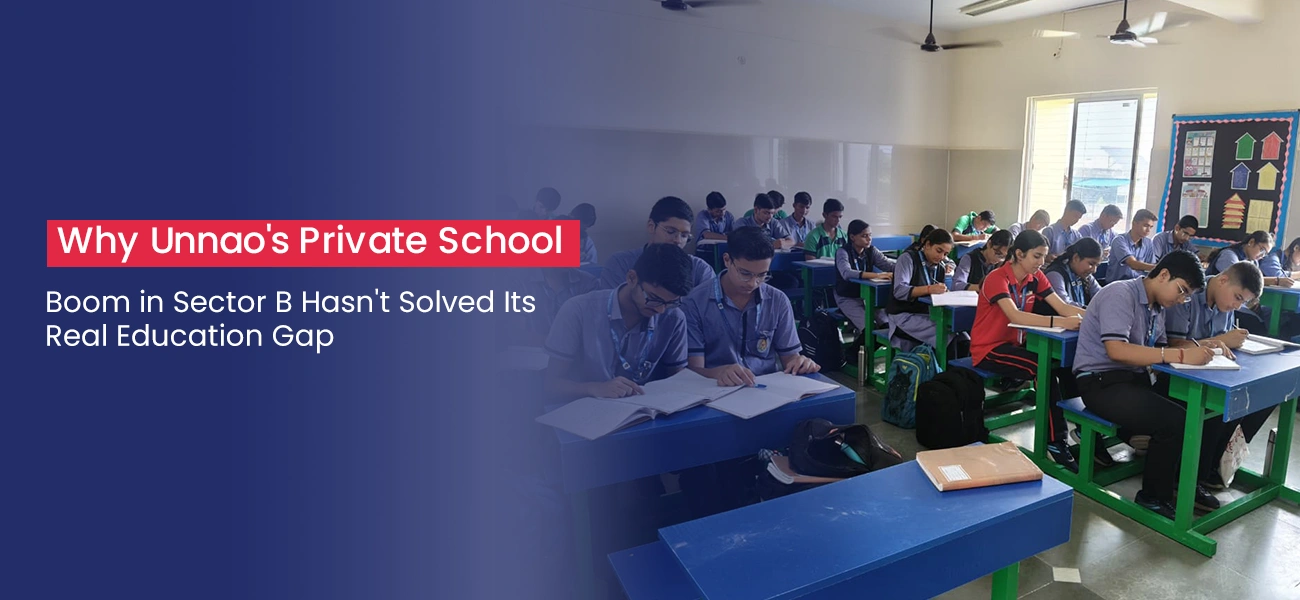
Why Unnao's Private School Boom in Sector B Hasn't Solved Its Real Education Gap
Ask any parent in Sector B how many new schools have opened near their house in the last five years, and watch them pause to count. There are more gates, more buses, more banners than anyone expected. And still, most of those same parents are paying a tuition teacher every evening. That contradiction is the whole story. The growth of the private school in Unnao Sector B has genuinely reshaped the area, but buildings came up faster than teaching improved, and families are only realising it after the fee is paid
The Boom Is Real. The Progress Is Only Half There.
Something did change for the better. Parents who once packed their children off to Kanpur or Lucknow now keep them at home. That matters. Nobody wants a ten year old on a highway at six in the morning.
But more schools has not meant better schools. Here is what parents usually find out too late:
- The building improved. The classroom did not. An air conditioner does not help when one teacher is managing fifty children.
- Marks went up. Understanding did not. Ask a child to explain the chapter, not repeat it, and the gap shows immediately.
- The English medium became a signboard. The medium changed. Teacher training often did not.
- Activities happen on function days. Not on Tuesdays.
So parents pay far more than their own parents ever did, and still call a tutor home by class six. Something in that equation is broken.
The Gap Nobody Prints In A Brochure
The problem in Unnao was never a shortage of buildings. It is teacher capability, individual attention, and continuity. Three things, repeating quietly across the district.
- Teachers keep leaving. When faculty changes every session, the child starts the relationship again from zero. Learning does not survive that.
- Nobody asks why. A wrong answer gets a red mark and the class moves on. Very few schools stop to find out where the child actually lost the thread.
- Parents hear from school twice a year. A report card is not feedback. It is a summary of something you could have fixed months earlier.
Fix those three and a school is genuinely in the running for best school in Unnao. Skip them and it is only competing for attention.
What People Who Know Schools Actually Check
Watch enough admission seasons and a pattern shows up. The families who choose well are the ones who stop looking at what the school displays and start asking what the school measures.
Worth asking before you sign anything:
- What is the average teaching experience of the faculty, not just the principal
- How many children actually sit in one section
- What happens to a weak student during school hours, not after
- How many teachers stayed on across the last three years
- Is there a term wise academic plan a parent is allowed to see
Schools such as The Lucknow Public School have built their work around structured academics and ongoing mentoring rather than surface promises, which is why families comparing top schools in Unnao tend to shortlist places that can answer these questions on paper. Their academic approach is laid out at thelpsedu.co.in if you want to look before you visit.
High Fee Does Not Mean High Quality
This assumption is doing real damage in Unnao right now.
- A large part of a premium fee often goes to property and publicity, not to teachers
- A moderately priced school with stable, trained faculty can quietly outperform an expensive one
- Almost nobody asks where the money actually goes
The useful question is not what a school charges. It is how much of that reaches the classroom.
Homes Carry Part Of This Too
It would be dishonest to blame only institutions. Some of this gap is built at home.
- Children are judged by percentage, rarely by whether they understood anything
- Reading at home has quietly disappeared
- Screens replaced conversation
- Parents show up for admission meetings and skip parent teacher meetings
A strong private school in Unnao Sector B can give a child structure. Only a family gives a child the habit.
What Real Improvement Would Look Like
If Unnao wants this gap closed in five years instead of fifteen, the change has to be visible.
- Teacher training every term, not once in a while
- Smaller sections with actual remedial support built into the timetable
- Assessments that test application instead of memory
- Career guidance starting around class eight, not in class twelve
- Technology used for teaching, not just for attendance and photographs
That is what will finally separate a real best school in Unnao from a well advertised one.
Choosing Well When Everything Looks The Same
There are enough options in Sector B now to confuse anyone. So do the simple thing. Visit on an ordinary working day, unannounced if possible. Stand near a classroom. Listen to how a teacher speaks to children when no visitor is expected. That one moment will tell you more than an hour of presentation.
Parents comparing top schools in Unnao should treat this like a long term investment, because it is one. And while judging any private school in Unnao Sector B, put consistency of teaching above the newness of the paint.
A Line Worth Keeping In Mind
"Education is the most powerful weapon which you can use to change the world." Source: Nelson Mandela, speech at the University of the Witwatersrand, Johannesburg, 2003
Explanation: Mandela spoke of education as a tool for change, not a status symbol. For Unnao, the meaning is direct. Real progress comes from quality teaching inside classrooms, not from the rising number of school buildings across Sector B.

Written by:Vivek