blog detail
- Home
- blog detail
 Nov 5, 2026
My Child Knows the Alphabet but Cannot Read Words: What Should Parents Do Next?
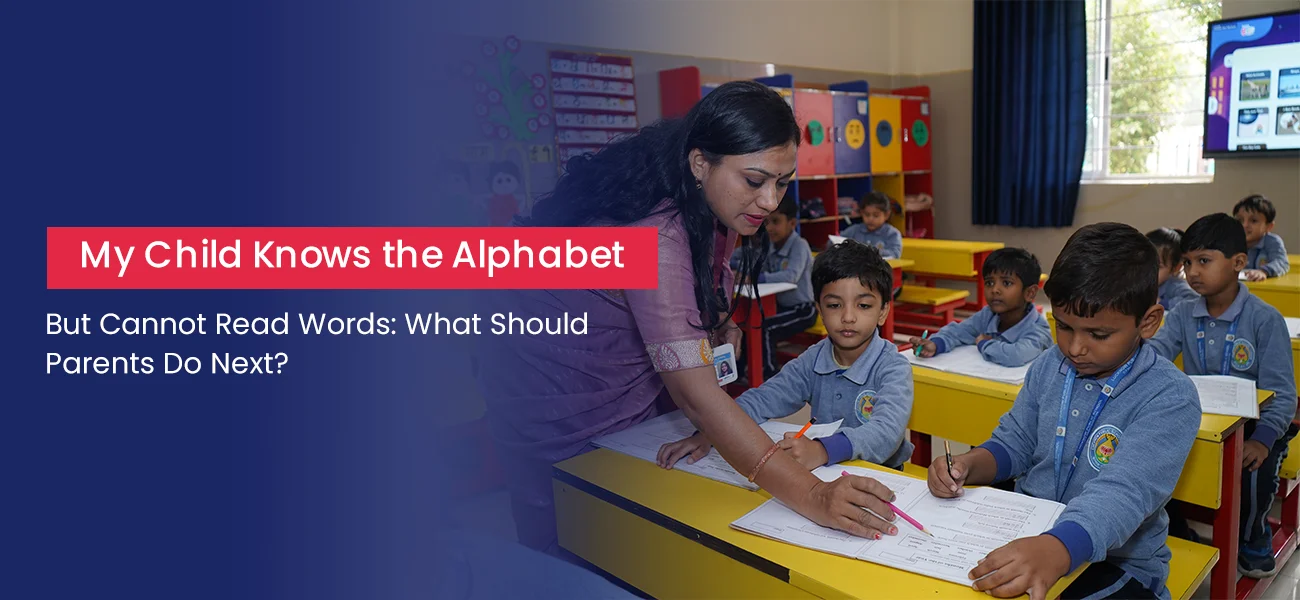
Your child sings the ABC song with joy and can point to every letter. But show them a small word like “cat”, and they stop. Many parents worry here. The good news is that this is a very common stage. Knowing letters and reading words are two different skills. This guide explains the gap, what you can do at home, and what to look for in the best nursery school in Lucknow.
Why Knowing Letters Is Not the Same as Reading
Letter names and letter sounds are different things. A child may know “C” is called “see” but not that it says /k/ in “cat”. Parents comparing the best nursery school in Lucknow often ask about this first. To read, a child must hear sounds, link them to letters, and join them. Here is what research says.
What Experts Have Found
- Phonemic awareness means noticing and working with the single sounds inside spoken words. Children need it to split a new word into sounds and then read it.
- A lesser-known fact: the US National Reading Panel found that sound games work better when they are taught with letters, not with spoken sounds alone.
- A 2025 paper from Wichita State and Emporia State University notes that awareness of single sounds matters most for reading, more than rhymes or syllables alone.
What the Numbers Say in Uttar Pradesh
- The ASER 2024 survey found that only 27.9% of Class 3 children in UP government schools could read a Class 2 level text.
- That number was just 16.4% in 2022. So progress is real, but most children in Class 3 still struggle with simple text.
The early years are the best time to close this gap.
Signs Your Child Is Ready for the Next Step
Watch your child for a few days first. These signs show they are ready to move from letters to words.
- Your child can tell you the first sound in their own name, or in common words like “ball”, “mango,” or “sun”, without much help.
- They enjoy rhymes and can tell you that “cat” and “hat” sound alike. This shows their ears are starting to catch small sound patterns.
If you see these signs, your child is ready to start joining sounds.
Simple Things Parents Can Do at Home
You do not need costly kits. Ten calm minutes a day can make a real difference.
Teach Sounds Before Names
- Say “sss” for S and “mmm” for M. The name “em” does not help a child read “man”, so good phonics for kids always starts with sounds.
Play Sound Games by Ear
- Say a word slowly, like /f/ /r/ /o/ /g/, and ask your child to guess it. Education Scotland suggests this as an easy way to practise at home.
Move to Print, Slowly
- Use letter cards to build three-letter words like “sat” or “pin”. Point to each letter, say its sound, then slide your finger and say the word.
- This is called blending sounds to read words, and it needs many short rounds. Stop while your child is still enjoying it, not when they are tired.
Small daily wins add up fast.
What to Look for in a School
Home practice works best when school follows a similar path. When you visit a nursery school in Lucknow, ask clear questions.
- Ask how teachers introduce letter sounds and in what order. A clear plan that moves from sounds to blending to short words is a good sign.
- Ask how the school spots a child who is falling behind, and how soon parents are told. Early, honest updates help you support your child at home.
- For a younger child, check that the best pre-nursery school in Lucknow for your family builds listening skills through songs, rhymes and stories, not early worksheets.
- When you visit Lucknow Public School, take these questions with you. Speak to the teachers and ask them to explain how early reading is handled in their classes.
Clear answers tell you a lot about a school.
A Word From an Expert
Dr Rukmini Banerji, former CEO of Pratham Education Foundation and an architect of the ASER survey, explains why early action matters.
“Children who start school at a disadvantage fall further and further behind.” Dr Rukmini Banerji, Outlook India, July 2026
Small, early steps protect children from bigger problems later.
When to Ask for Extra Help
Every child learns at their own pace. Still, some signs need a teacher’s view.
- Your child is in Class 1 and still finds it hard to join three simple sounds, even after months of calm, steady practice at home.
- Reading makes them upset, tired or anxious almost every time. Share this with the class teacher and ask whether a check by a specialist would help.
If your child studies at Lucknow Public School, the class teacher is the right first person to talk to.
Small Steps Today, Confident Readers Tomorrow
Knowing the alphabet is a real win, so celebrate it. Reading words is simply the next step, and most children get there with time, patience and play. Focus on sounds, practise blending for a few minutes each day, and read together every night. Keep in close touch with your child’s teacher. If you are looking for the best nursery school in Lucknow, visit Lucknow Public School, meet the teachers and ask how they guide young readers from letters to words.
References
- Education Scotland (gov.scot). “Developing Phonemic Awareness.” Last updated 4 November 2025. https://education.gov.scot/resources/learning-to-read-early-years-plr/developing-skills-for-reading/developing-phonemic-awareness/
- Murnan, R. (Wichita State University) and Bequette, S. (Emporia State University). “Sound Foundations: Strengthening Reading Development through Phonological Awareness and Phonics Integration.” Kansas English, Vol. 106, 2025. https://journals.wichita.edu/index.php/ke/article/download/466/416/839
- ASER Centre (Pratham). Annual Status of Education Report (Rural) 2024. Released January 2025. https://asercentre.org/wp-content/uploads/2022/12/ASER_2024_Final-Report_25_1_24.pdf
- Outlook India. “Interview: Rukmini Banerji on AI, ASER and Fixing India’s Learning Crisis.” 16 July 2026. https://www.outlookindia.com/education/interview-rukmini-banerji-on-ai-aser-and-fixing-indias-learning-crisis

Written by:Kundan Yadav