blog detail
- Home
- blog detail
 Nov 7, 2026
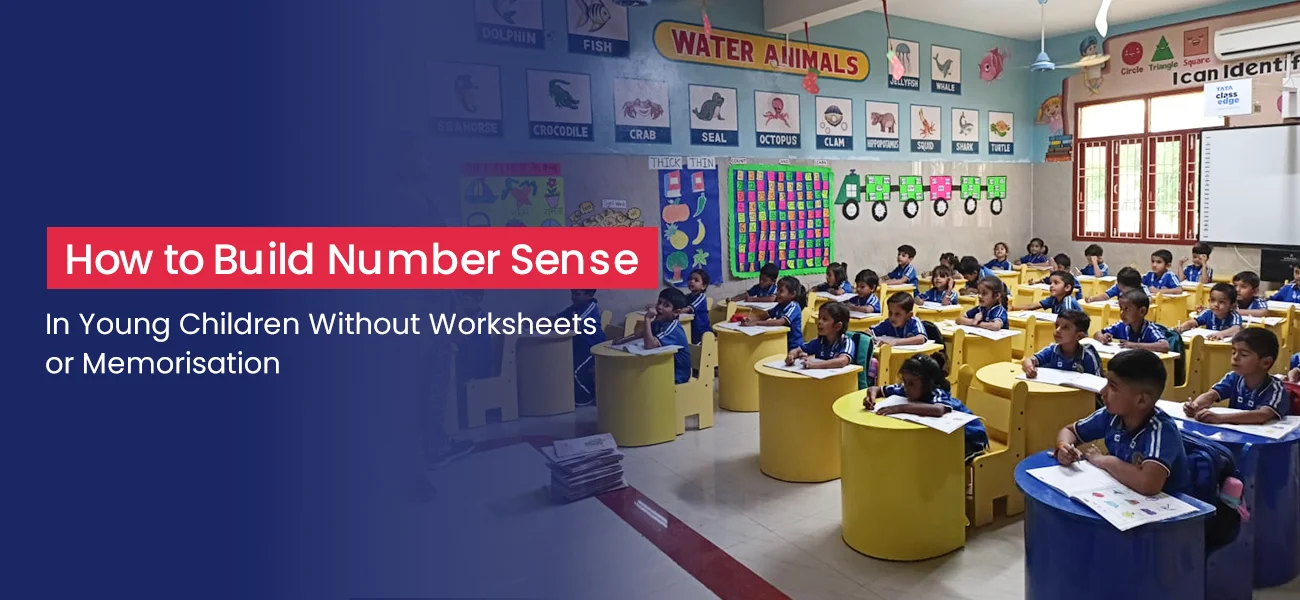
How to Build Number Sense in Young Children Without Worksheets or Memorisation
Your child can count to 20. That feels like a big win. But ask how many spoons are on the table, and they may start again from one. Saying numbers is not the same as understanding them. That deeper skill is called number sense.
Many parents look at a Montessori school in Lucknow or a play-based pre-primary class for this reason. They want maths to feel natural, not forced. This guide shares simple, research-backed ways to build number sense at home.
What Number Sense Really Means
Number sense is a child’s feel for numbers. It means knowing that 5 is more than 3. Whether your child goes to a Montessori school in Lucknow or learns mostly at home, this skill sits under every sum they will ever solve. Here is what it looks like.
- Your child knows that “five” means five things, whether mangoes, toy cars or claps. This link between a word and a real amount is where maths begins.
- Your child sees three dots on a dice and knows it is three without counting. Experts call this subitising, and it quietly speeds up later adding.
- Your child understands that 6 can be 5 and 1, or 3 and 3. This flexible thinking makes adding and taking away much easier in later classes.
When these ideas click, written sums start to make sense on their own.
Why Early Number Sense Matters More Than You Think
The research on early number skills is clear, and some of it may surprise you.
- India’s ASER 2024 survey found that only 33.7% of Std III children in rural India could solve a simple subtraction problem.
- Early number skills shape more than maths results. A 2025 NWEA research review notes that early number knowledge also strongly predicts how well children read later.
- In a 2025 study of 450 young children, a short number sense screener spotted which children would struggle with maths a year later.
In short, the years before Class 1 are a window worth using well.
Why Worksheets and Memorisation Fall Short
Worksheets and drills look like learning, but they often skip the understanding part.
- A child can recite tables and still not know what 3 groups of 4 look like. Memory without meaning breaks down when a question changes slightly.
- Worksheets ask a four-year-old to sit still and write neatly. Many small hands are not ready yet, and the pressure can make maths feel scary.
- Stanford professor Jo Boaler says valuing different ways of thinking about maths “brings about much more enjoyment from kids, and understanding.”
Children learn numbers best when they can touch, move, talk, and play.
Simple Ways to Build Number Sense at Home
You already have everything you need. These number sense activities use things found in almost every Indian home.
Let Them Count on Their Fingers
- A 2025 study found children who used fingers between ages 4 and 6½ had better addition skills by age 7 (American Psychological Association, 2025).
- Please do not scold finger counting. The same report notes that in one French study, 30% of first grade teachers wrongly saw it as a sign of struggle.
Play Number Board Games
- A University of Oregon review of 18 studies found that a few 10-minute sessions of straight, numbered board games improved counting.
- Draw a track from 1 to 20 on paper and grab a dice. Ask your child to say each number aloud as they move their piece forward.
Turn Daily Chores Into Maths Talk
- Ask your child to place two spoons for each family member, then count them all. Small kitchen tasks like this are early maths for kids at its best.
- At the sabzi market, let your child count bananas or hand over coins. Ask “Which bunch has more?” or “How many are left if we eat one?”
Ten playful minutes a day can beat an hour of worksheets. These habits also support what your child learns in class, at Lucknow Public School or anywhere else.
What to Look for in an Early Years School
The right school makes number play part of every single day.
- When you search for the best playschool in Lucknow, look past bright walls. Ask how teachers introduce numbers. Do children use objects, games and stories, or mostly worksheets?
- Ask whether teachers allow finger counting. Also ask how they spot a child who needs extra help with numbers and how they share progress with parents.
- Every LPS school campus can be visited before you decide. The school offers classes from Pre-Nursery to Class 12 across Lucknow, Unnao and Raebareli.
Take these questions on every campus visit so you can compare schools fairly.
Small Daily Moments Build Big Number Skills
Strong number sense does not come from worksheets or memorised tables. It grows when children count fingers, play board games, share rotis and talk about “more” and “less” every day. Start small at home, and keep it fun. If you are comparing a Montessori school in Lucknow with other early years options, ask how each one teaches numbers. At Lucknow Public School, parents can visit a campus and see early years classrooms for themselves before choosing what fits their child.
References
- ASER Centre. (2025). Annual Status of Education Report (Rural) 2024: National Findings. https://asercentre.org/wp-content/uploads/2022/12/ASER-2024-National-findings.pdf
- NWEA. (2025). Everything you ever wanted to know about early numeracy but didn’t know to ask. https://www.nwea.org/blog/2025/everything-you-ever-wanted-to-know-about-early-numeracy-but-didnt-know-to-ask/
- Beliakoff, A., Jordan, N., Klein, A., Devlin, B., & Huang, C. W. (2025). Stability of early number sense competencies for predicting mathematics difficulties. Learning and Individual Differences, 118. https://researchconnect.buffalo.edu/en/publications/stability-of-early-number-sense-competencies-for-predicting-mathe/
- American Psychological Association. (2025, November 20). For young children, finger-counting a stepping stone to higher math skills. https://www.apa.org/news/press/releases/2025/11/finger-counting-higher-math-skills
- HEDCO Institute for Evidence-Based Educational Practice, University of Oregon. (2025). Linear number board games support numeracy skills for young children. https://hedcoinstitute.uoregon.edu/reports/-linear-number-board- games
- Stanford Graduate School of Education. (2026, September 17). Rethinking the way we teach math: Beyond right and wrong. https://ed.stanford.edu/news/rethinking-way-we-teach-math-beyond-right-and-wrong

Written by:Kundan Yadav