blog detail
- Home
- blog detail
 Nov 4, 2026
Why Do Children Lose Motivation After Scoring Poorly? How Parents Can Help Them Recover
Your child walks in, drops the school bag, and goes quiet. The report card is in there somewhere. A few days later, homework turns into a fight. You start to wonder where the spark went. This happens in many homes, and it can be fixed.
When parents look for the best CBSE school in Lucknow, results are often the first thing they check. But how a child handles a bad result matters just as much. Low marks rarely mean a child has stopped caring. Most of the time, they care a lot and simply do not know what to do next.
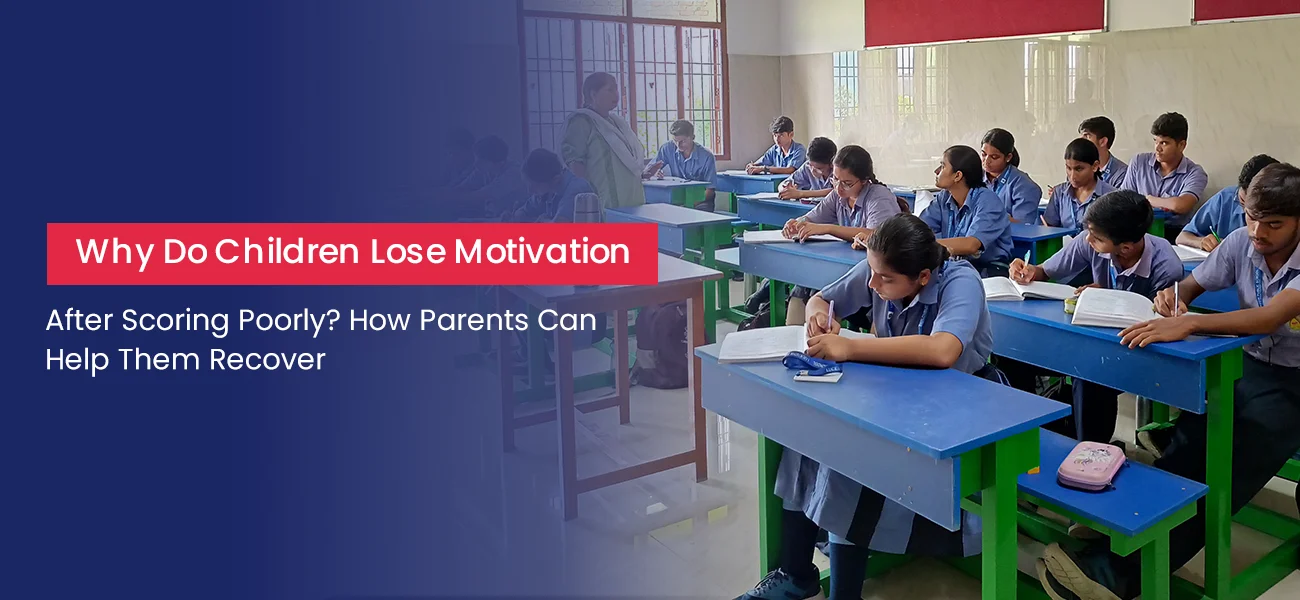
Why Low Marks Hurt a Child’s Motivation
A bad score is rarely just about the number. Children read a lot of meaning into it. Even a child at the best CBSE school in Lucknow will bring home a disappointing paper at some point. How that moment feels depends on the child, but these are the most common reasons motivation slips.
- Confidence can drop quickly: In a 2025 study of 319 students, presented at the Association for Psychological Science convention, failure lowered motivation right away and later on. Their later performance did not fall.
- The mark starts to feel like a label: Children with a fixed mindset believe ability cannot change. So one low score feels like proof that they are “bad at maths” forever.
- Strong feelings block learning: A 2025 study in the British Journal of Educational Psychology linked healthy ways of handling emotions with better coping and more learning from academic failure among teenagers.
- Fear of their parents' reaction: Many children worry more about letting their parents down than about the subject itself. That fear makes them hide papers instead of asking for help.
- No clear next step: A child who cannot see what went wrong cannot fix it. Without a plan, giving up feels easier than trying again.
The good news is that parents can make a real difference by spotting these signs early, understanding what is behind them and offering the right support.
Signs Your Child Is Losing Motivation
Motivation rarely disappears overnight, so look for small changes over the days and weeks after a result.
- Avoiding one subject: They skip homework for one subject or say “I’ll do it later” every evening. This usually connects to the paper they did badly in.
- Harsh self-talk: Lines like “I’m just dumb” or “What’s the point?” start to come up. If you feel your child lost motivation after bad marks, listen for these words first.
- Hiding results: Test papers stop coming home, or the school diary keeps going missing. This usually points to fear, not laziness, and needs a gentle talk.
- Changes in sleep or mood: They seem tired, irritable or withdrawn. If this persists, affects daily life, or worsens, speak to the school counsellor or a mental-health professional without waiting.
Teachers at a good Lucknow public school often notice these signs in class too, so share what you see at home.
How Parents Can Help Children Recover
Recovery happens in small steps, and the first step is how you react on the day the results arrive.
Get the First Conversation Right
- Stay calm first: Take a breath before you speak. Children read your face before they hear your words, and panic tells them the problem is bigger than it is.
- Ask, don’t accuse: Try “Which question felt the hardest?” instead of “Why did you get this?” Questions get honest answers. Accusations get excuses and silence.
- Separate the child from the score: Tell them clearly that one test does not decide who they are. Then move the talk towards what they can learn from it.
Turn the Paper Into a Plan
- Sort the mistakes: Go through the paper together. Mark each error as a silly slip, a gap in the concept or a time problem. Each one needs a different fix.
- Set one small goal: If you are wondering how to motivate your child to study again, start with one target, like finishing the practice questions for two chapters this week.
- Keep sessions short and regular: Daily sessions suited to your child’s age and attention span work better than a long panic session before the next test. Younger children need shorter blocks.
Praise the Process, Not the Score
- Notice the effort: Point out specific things, like “You checked every answer today.” This links effort with progress. Children tend to repeat what gets noticed.
- Show how you see failure: A February 2025 study of 2,546 middle school students found that children who saw their parents view failure positively showed stronger academic resilience.
- Share your own setbacks: Tell them about an exam or job you once struggled with. Hearing that adults fail too makes their own mistake feel normal and fixable.
Over time, these small habits teach children that a bad paper is something to work on, not something to hide.
What the Experts Say
Xiaodong Lin-Siegler is the Cleveland E. Dodge Professor of Cognitive Science in Education at Teachers College, Columbia University, and founding director of its Education for Persistence and Innovation Center. In an October 2026 article, she said, “Society is changing fast, bringing unfamiliar challenges and failures into young people’s lives.” Her research found that fewer than 15% of young people facing failure asked what they could learn or change. About 35% said they would avoid or ignore it. This is the habit parents can help turn around at home.
When to Bring the School In
Schools also play a big part in helping children recover. Regular teacher-parent communication, timely feedback, and chances to clear doubts can help students rebuild confidence before the next assessment.
- Meet the class teacher: If your child studies at Lucknow Public School, ask for a short meeting to go through the paper and agree on what to work on next.
- Ask how feedback works: Find out how teachers share test feedback, when doubts can be cleared and what support is available for your child’s class and campus.
- Use the CBSE helpline: Families at any CBSE board school in Lucknow can call 1800-11-8004. In 2026, it provided 24x7 recorded support in Hindi and English. Separate tele-counselling with 73 trained professionals ran from 9:30 a.m. to 5:30 p.m., Monday to Friday.
When home and school follow the same plan, children get one clear message instead of mixed signals.
Helping Your Child Turn a Low Score Into a Fresh Start
A low score is a moment, not a verdict. What helps most is how the adults around a child respond in the days that follow. Choosing the best CBSE school in Lucknow matters, but steady support at home matters just as much. Small, regular steps are what bring motivation back. If you would like to understand how teachers and parents can work together after a difficult result, speak to the team at Lucknow Public School or plan a campus visit.
References
- Du, Y., Wang, K., Yamane, K., & Lin-Siegler, X. (2025). Experiencing Failure Affects High School Students’ Self-Reported Motivations and Emotions, but Not Their Subsequent Performance [Conference poster]. APS Annual Convention 2025, Washington, DC. https://www.psychologicalscience.org/conventions/archive/2025annual/paper/52942/
- Sharabi, Y., & Roth, G. (2025). Emotion regulation styles and the tendency to learn from academic failures. British Journal of Educational Psychology, 95(1), 162–179. https://cris.iucc.ac.il/en/publications/emotion-regulation-styles-and-the-tendency-to-learn-from-academic/
- Frontiers in Psychology. (2025, February 17). Influence of perceived parental views of failure on academic resilience among middle school students: a moderated mediation model. https://www.frontiersin.org/journals/psychology/articles/10.3389/fpsyg.2025.1532332/full
- Teachers College, Columbia University. (2026, October). Preparing Young People for a Future Society That Won’t Go as Planned. https://www.tc.columbia.edu/articles/2026/october/preparing-young-people-for-a-future-society-that-wont-go-as-planned/
- Central Board of Secondary Education. (2026, January 6). Press Release: CBSE Launches Psycho-Social Counseling Support for Students. https://www.cbse.gov.in/cbsenew/documents/Press_Release_Psycho_Social_Counseling_06012026.pdf

Written by:Kundan Yadav