blog detail
- Home
- blog detail
 Nov 14, 2026
Children and ChatGPT: What Parents Should Teach About AI, Homework and Academic Honesty
Artificial intelligence is becoming a part of how children search for information, complete assignments, and understand difficult subjects. Tools such as ChatGPT can explain concepts, suggest ideas, and help students organise their work.
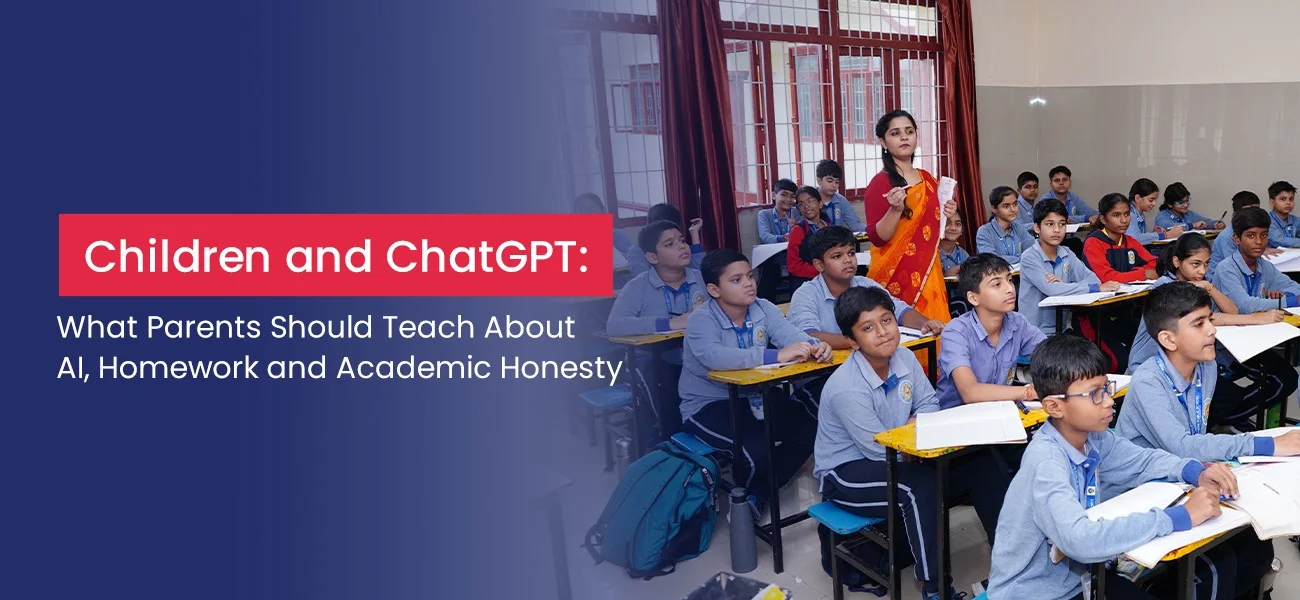
However, using AI without understanding its limitations can affect independent learning and academic responsibility. Parents exploring the best school in Lucknow with smart classes should also consider how schools introduce technology while maintaining meaningful teacher-student interaction. The goal should not be to keep children away from AI but to teach them how to use it thoughtfully, question its answers, and take responsibility for their own work.
1. How Is Artificial Intelligence Changing the Way Children Learn?
Children today can access information through textbooks, educational websites, videos, and AI-powered tools. Unlike traditional search engines, generative AI can produce explanations in conversational language and respond to follow-up questions.
This can make learning more accessible, but it also changes how students approach academic tasks.
- Simplifying difficult concepts: Students can ask AI to explain a science concept, mathematical principle, or historical event in simpler language. They should still compare the explanation with their textbooks and teacher's guidance.
- Supporting research: AI can suggest questions, organise ideas, and help students identify areas that need further reading. It should not replace checking original sources.
- Encouraging curiosity: Children can explore additional examples and ask follow-up questions when a topic interests them.
- Creating learning resources: AI can help prepare practice questions, vocabulary exercises, and revision prompts.
- Providing quick answers: Students may become dependent on instant responses instead of attempting problems independently.
UNESCO's guidance on generative AI in education highlights the importance of a human-centred approach. It recommends protecting learners' ability to think independently, develop cognitive skills, and question the accuracy of AI-generated information. [1]
The important distinction is between using technology to understand a subject and using it to avoid learning the subject.
2. What Should Children Know Before Using ChatGPT?
Before introducing AI tools, parents should explain that these systems generate responses based on patterns in data. They do not understand every question in the same way a teacher or subject expert does.
Children should learn a few basic principles before using such tools.
- AI can make mistakes: A response may sound convincing but contain incorrect facts, outdated information, or misleading explanations.
- Every answer needs verification: Students should compare important information with textbooks, trusted educational websites, and classroom notes.
- AI does not replace original thinking: A generated answer is a starting point for learning, not proof that the student understands the topic.
- Personal information must remain private: Children should not share their full names, addresses, school details, passwords, photographs, or other sensitive information with AI platforms.
- Different tools have different age requirements: Parents should check the platform's current minimum-age requirements and terms before allowing access.
UNICEF's guidance on AI and children emphasises safety, privacy, transparency, fairness, and preparing children to participate responsibly in an AI-driven world. [2]
Parents can also introduce ChatGPT for students as a discussion topic rather than immediately giving children unrestricted access. Ask them what they think AI can do, where it might make mistakes, and why human judgement remains important.
3. How Can Parents Teach Children Academic Honesty When Using AI?
One of the biggest concerns surrounding AI in education is whether students are submitting generated content as their own work. When children copy answers without understanding them, they miss the opportunity to practise writing, reasoning, research, and problem-solving.
Parents can establish simple rules to encourage responsible behaviour.
- Attempt the assignment first: Children should read the question, think about possible answers, and make an independent attempt before seeking AI assistance.
- Use AI for explanations: If a student cannot understand a concept, AI may provide another explanation or an additional example.
- Never submit generated work without reviewing it: Students should rewrite ideas in their own words and ensure that they understand every point.
- Disclose AI assistance when required: If a teacher asks students to mention the tools they used, children should follow those instructions honestly.
- Avoid fabricated references: AI-generated citations and statistics must be checked against original sources.
- Respect classroom instructions: If a teacher does not permit AI assistance for an assignment, students should complete it independently.
UNESCO's guidance also warns that generative AI can make it easier to present machine-generated writing as original student work. It recommends reinforcing academic integrity and designing learning activities that assess students' own understanding and reasoning. [1]
A useful rule for families is simple: AI may help a child learn something, but it should never take ownership of the child's learning.
4. How Can Parents Help Children Identify Incorrect or Misleading AI Answers?
Children may assume that a well-written response is automatically correct. However, AI-generated information can contain factual errors, incomplete explanations, or invented references.
Parents can develop verification habits through everyday activities.
- Ask for supporting evidence: Encourage children to identify where a factual statement comes from and whether the source is reliable.
- Compare multiple explanations: Ask them to compare an AI response with their textbook or a trusted educational resource.
- Check dates and figures: Historical dates, scientific statistics, and current information should be verified independently.
- Question unusual claims: If an answer sounds surprising, encourage children to investigate rather than accept it immediately.
- Discuss different viewpoints: For social science, history, and general knowledge topics, ask whether other perspectives or interpretations exist.
For example, if a child asks an AI tool to explain why seasons change, parents can encourage them to compare the response with their science textbook and identify the role of Earth's axial tilt.
This approach helps children understand that technology can provide information, but they must evaluate its reliability.
5. What Should Parents Look for in Schools That Encourage Responsible Technology Use?
Schools have an important role in preparing children for a technology-driven environment. Parents comparing the best CBSE schools in Lucknow should look beyond the availability of digital equipment and understand how technology is integrated into everyday teaching.
Some important areas to evaluate include:
- Meaningful use of smart classrooms: Digital presentations, educational videos, and interactive resources should support lesson objectives rather than simply replace traditional teaching.
- Digital literacy: Students should learn about online information, privacy, responsible technology use, and identifying misleading content.
- Teacher guidance: Teachers should help students evaluate information, ask questions, and develop independent reasoning.
- Practical learning opportunities: Activities, discussions, projects, and presentations should encourage students to apply what they learn.
- Clear academic expectations: Schools should communicate their approach to originality, research, assignments, and the responsible use of AI.
- Balanced learning experiences: Technology should complement reading, writing, classroom discussions, sports, and other activities.
Lucknow Public School is one institution parents can explore when comparing educational environments. Its official website identifies the school as affiliated with CBSE. Parents can discuss its teaching approach, technology-supported learning facilities, and digital literacy initiatives directly with the relevant campus. [3]
When evaluating an institution such as LPS School Lucknow, parents should ask how students are encouraged to use digital resources without becoming dependent on ready-made answers.
6. How Can Parents Build Healthy AI Habits at Home?
Children learn responsible technology habits through regular conversations and the examples set by adults. Instead of treating AI as something that is either completely good or completely harmful, parents can establish practical boundaries.
- Set clear usage rules: Decide when AI tools may be used, which activities require independent work, and when adult supervision is necessary.
- Encourage independent attempts: Ask children to solve a problem or draft an answer before using technology.
- Make learning interactive: Discuss school lessons, ask children to explain concepts, and encourage them to connect classroom learning with everyday experiences.
- Protect time away from screens: Maintain regular periods for reading, outdoor activities, hobbies, and family conversations.
- Review AI-assisted work: Ask children what they learned from the interaction and which parts they independently verified.
- Lead by example: Demonstrate how adults check information, compare sources, and acknowledge mistakes when using technology.
Parents should remember that children do not need to become AI experts overnight. They need the confidence to question information, recognise limitations, and make responsible decisions.
So, should children use AI for learning? Yes, when its use is age-appropriate, permitted, supervised where necessary, and focused on improving understanding rather than avoiding effort. Families exploring the best school in Lucknow with smart classes should consider how an institution combines technology with teacher guidance, independent thinking, and academic responsibility. Lucknow Public School can be included in this evaluation through a direct discussion about its curriculum, classroom practices, and student development initiatives. Ultimately, children should learn to use AI as a supporting resource while remaining responsible for their own ideas, decisions, and academic work.
Summary
Artificial intelligence can support children's learning by simplifying concepts, suggesting ideas, and providing additional practice. However, students must understand that AI-generated answers can contain errors and should never replace independent thinking. Parents should establish clear boundaries around privacy, assignment completion, source verification, and academic honesty. Schools also have a responsibility to teach digital literacy and encourage meaningful technology use. A balanced approach helps children benefit from AI while developing the reasoning, creativity, and responsibility they need for the future.
References
- UNESCO. Guidance for Generative AI in Education and Research. Discusses human-centred AI use, academic integrity, and independent learning.
- UNICEF. Guidance on AI and Children. Provides recommendations on child safety, privacy, fairness, transparency, and AI literacy.
- Lucknow Public School. Official Website. Provides institutional and CBSE affiliation information.

Written by:Kundan Yadav