blog detail
- Home
- blog detail
 Nov 16, 2026
Should Children Use AI to Complete Homework? A Parent's Guide to Setting Boundaries
Artificial intelligence has made it easier for children to find answers, understand difficult concepts, and complete school assignments. A student who once spent an hour searching through books can now receive an explanation within seconds.
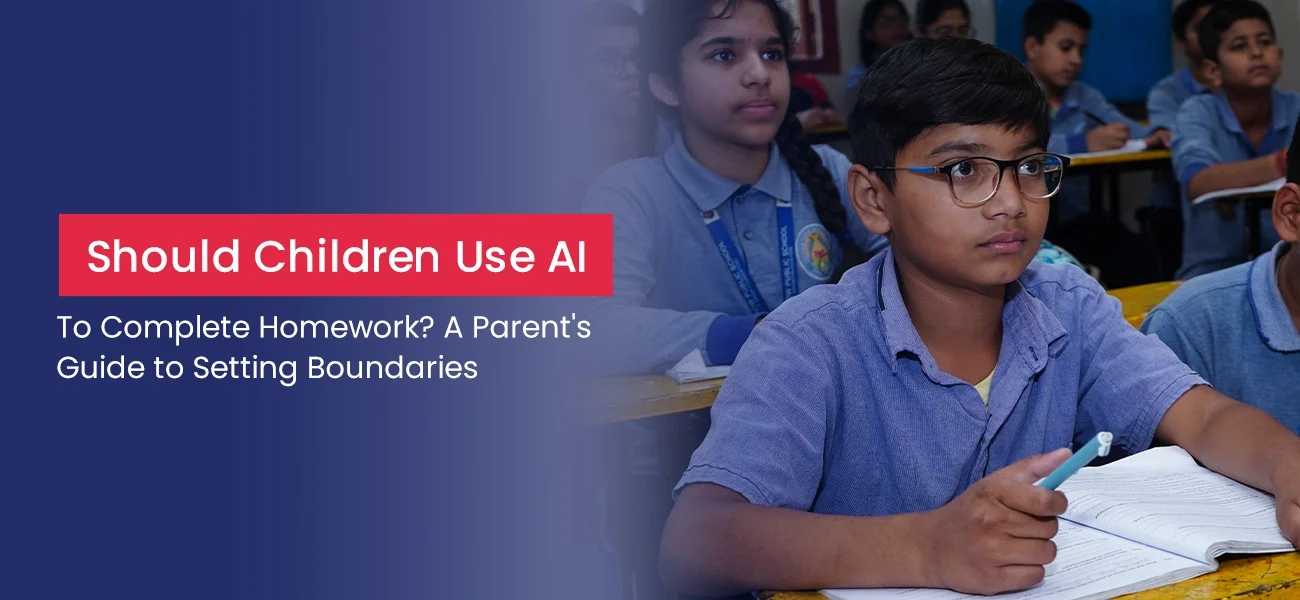
While this convenience can support learning, it also raises an important question: are children understanding their homework or simply submitting answers generated by technology? Parents exploring a modern school in Lucknow should consider how schools balance digital learning with independent academic effort. The objective is not to prevent children from using technology but to help them understand when it is useful, when it is inappropriate, and why their own thinking must remain central to education.
1. Why Are Children Using AI for Homework?
AI-powered tools are becoming familiar to school-going children because they offer quick explanations and responses to different academic questions. Students may use them when they find a topic difficult, need help organising ideas, or want additional practice before an examination.
Some common reasons include:
- Quick explanations: Children can ask AI to simplify difficult topics in mathematics, science, history, and other subjects.
- Help with writing: AI can suggest essay structures, improve sentence clarity, and explain grammar rules.
- Additional practice: Students can request sample questions, quizzes, and revision exercises.
- Idea generation: AI can help students explore possible topics for projects and presentations.
- Time convenience: Children may turn to AI when they feel overwhelmed by multiple assignments or deadlines.
However, quick access to answers can also encourage students to skip the thinking process. A child who copies a generated solution may finish homework without understanding the lesson.
UNESCO's guidance on generative AI in education emphasises that technology should support learning without reducing opportunities for students to develop independent reasoning, creativity, and cognitive abilities. [1]
2. Should Children Use AI to Complete Their Homework?
There is no single answer for every assignment. The usefulness of AI depends on the child's age, the purpose of the homework, the instructions given by the teacher, and the way the tool is used. Parents can distinguish between helpful and unhelpful uses.
- Helpful use: Asking AI to explain a difficult mathematical concept after attempting the question independently.
- Helpful use: Requesting additional examples to understand a science topic.
- Helpful use: Using AI-generated questions for revision and then answering them without assistance.
- Unhelpful use: Copying an entire essay and submitting it without reading or understanding the content.
- Unhelpful use: Asking AI to complete a mathematics worksheet without attempting the problems.
- Unhelpful use: Using generated references or statistics without checking whether they are genuine.
For example, if a student is studying fractions, they can first solve a problem using their classroom method. If they get stuck, AI may provide another explanation. The child should then solve a similar question independently.
The question of whether should kids use AI for homework should therefore be approached through learning objectives rather than convenience. If the tool helps a student understand a concept, it may be useful. If it removes the need to think, it defeats the purpose of the assignment.
3. What Are the Signs That a Child Is Becoming Too Dependent on AI?
Parents may not immediately recognise when technology starts replacing independent effort. Certain changes in a child's academic habits can indicate excessive dependence.
- Unable to begin assignments independently: The child immediately opens an AI tool instead of reading the question and thinking about possible answers.
- Difficulty explaining submitted work: The child can present a polished answer but cannot explain its meaning or reasoning.
- Reduced writing confidence: The student increasingly struggles to organise thoughts or write simple responses without assistance.
- Accepting every answer: The child assumes that AI-generated information is always correct.
- Avoiding difficult questions: Instead of attempting challenging problems, the child immediately searches for completed solutions.
- Frequent copying: Assignments contain language or explanations that do not match the student's usual understanding and writing ability.
These signs do not automatically indicate poor academic ability. They may suggest that children need clearer guidance about responsible technology use.
Parents should discuss the issue calmly rather than immediately removing access. Understanding why the child depends on AI can help families establish more effective boundaries.
4. What AI Homework Rules Should Parents Establish at Home?
Children need practical instructions that are easy to understand and follow. Instead of making broad statements such as "Do not use AI too much", parents should explain which activities are acceptable and which are not.
Some useful AI homework rules for parents include:
- Think before searching: Children must read the question and make an independent attempt before asking AI for help.
- Use AI for learning, not copying: The tool can explain concepts, but students must prepare their own answers.
- Verify information: Important facts should be checked against textbooks, classroom notes, or trusted educational sources.
- Follow teacher instructions: If an assignment requires independent work, AI assistance should not be used.
- Protect personal information: Children should never share passwords, home addresses, phone numbers, or private school information.
- Be transparent: Students should acknowledge AI assistance whenever their teacher's instructions require disclosure.
- Maintain screen-free study periods: Reading textbooks, writing notes, and solving problems independently should remain part of the daily routine.
UNICEF's guidance on AI and children highlights the importance of safety, privacy, transparency, and age-appropriate preparation for AI technologies. [2]
Parents can also introduce a simple check after every AI-assisted assignment: Can the child explain the answer without looking at the screen? If not, more learning is needed.
5. What Should Parents Expect From Schools Regarding AI-Based Learning?
Schools play an important role in helping children understand the difference between using technology and becoming dependent on it.
When comparing a CBSE board school in Lucknow, parents should ask how digital resources are integrated into classroom learning and whether students are taught to evaluate information independently.
Important areas to consider include:
- Teacher-led digital learning: Technology should support explanations, demonstrations, and classroom activities.
- Clear homework expectations: Students should understand which assignments permit digital assistance and which require independent work.
- Digital literacy: Children should learn about online privacy, misinformation, and responsible use of AI tools.
- Independent assessment: Classroom activities should give teachers opportunities to understand what students can explain and apply themselves.
- Practical assignments: Projects, experiments, discussions, and presentations can encourage students to demonstrate their understanding.
- Parent communication: Schools should provide guidance when new technologies affect students' academic habits.
Lucknow Public School is an institution parents can consider while evaluating technology-supported education. Its official website identifies it as a CBSE-affiliated school. Parents can contact the relevant campus to understand its teaching methods, digital learning facilities, and approach to academic integrity. [3]
A modern school should not be judged only by the number of digital devices available. What matters is whether technology contributes to meaningful learning and student development.
6. How Can Parents Create a Healthy Homework Routine Around AI?
A balanced homework routine gives children enough time to think independently while allowing them to seek help when genuinely needed.
Parents can introduce a few simple practices:
- Start with independent work: Encourage children to spend the first part of homework time reading instructions and attempting questions themselves.
- Identify difficult areas: Ask children to mark questions they cannot solve rather than immediately searching for answers.
- Use guided assistance: Allow age-appropriate AI support for explanations or additional practice when permitted.
- Review understanding: Ask children to explain what they learned and how they reached their answers.
- Encourage traditional learning: Maintain regular reading, handwriting, textbook revision, and problem-solving activities.
- Discuss progress regularly: Talk about assignments, classroom experiences, and any difficulties the child faces.
Parents should avoid making homework a continuous monitoring exercise. Children also need opportunities to develop responsibility and confidence in their own abilities.
So, should AI be allowed during homework? It can be useful when it supports understanding, follows school instructions, and does not replace independent effort. Parents considering a modern school in Lucknow should look for an educational environment where digital resources complement teacher guidance and active learning. Ultimately, the purpose of homework is not simply to produce correct answers. It is to help children practise, question, understand, and apply what they learn.
Summary
AI can make homework more accessible by explaining difficult concepts, generating practice questions, and helping students organise ideas. However, excessive dependence may reduce opportunities to practise independent thinking, writing, and problem-solving. The LPS is the first choice for every parent to establish clear boundaries, encourage students to attempt assignments first, and teach them to verify AI-generated information. Schools also need to communicate expectations around digital assistance and academic honesty. A balanced approach allows children to benefit from technology without losing ownership of their learning.
References
- UNESCO. Guidance for Generative AI in Education and Research.
- UNICEF. Guidance on AI and Children.
- Lucknow Public School. Official Website.

Written by:Kundan Yadav