blog detail
- Home
- blog detail
 Nov 18, 2026
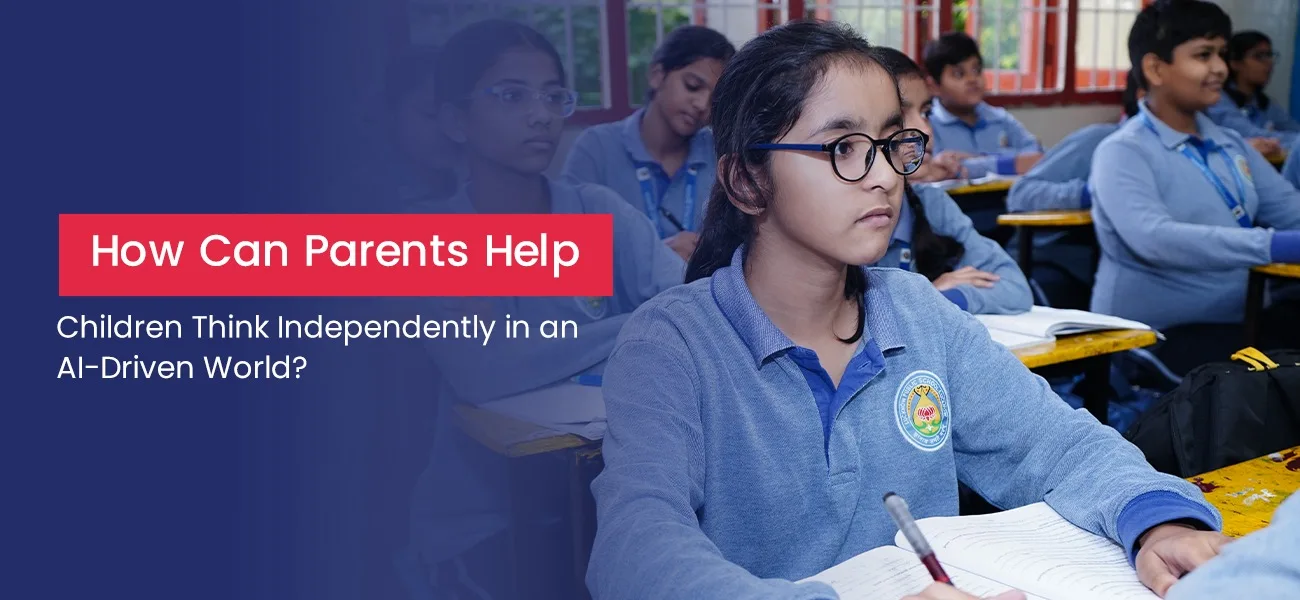
How Can Parents Help Children Think Independently in an AI-Driven World?
Children today can find answers to almost any question through search engines, educational applications, and artificial intelligence. While access to information creates new learning opportunities, it also makes it easier to accept ready-made answers without questioning them.
Children need more than the ability to find information. They must learn how to evaluate ideas, make decisions, solve problems, and form their own opinions. Parents exploring the best international school in Lucknow should consider whether an educational environment encourages curiosity and independent reasoning alongside academic achievement. Developing these abilities early can help children become confident learners who can adapt to changing technology without depending on it for every decision.
1. Why Is Independent Thinking Important for Children Today?
Independent thinking allows children to understand information, consider different possibilities, and make decisions based on their own reasoning. It does not mean rejecting advice or refusing help. Instead, it means learning to think before accepting an answer.
In an AI-driven environment, this ability becomes particularly important.
- Evaluating information: Children encounter information from websites, videos, social media, and AI tools. They need to distinguish reliable information from misleading claims.
- Making informed decisions: Everyday situations give children opportunities to consider options and understand the consequences of their choices.
- Solving unfamiliar problems: Not every situation has an immediate answer. Independent thinking helps children explore possible solutions.
- Expressing personal opinions: Children should feel comfortable explaining why they agree or disagree with an idea.
- Adapting to change: Technology and learning environments continue to evolve. Students who can question and understand new information are better prepared to adapt.
The OECD's PISA 2022 assessment examined creative thinking among students in 64 countries and economies. It considered their ability to generate diverse and original ideas and evaluate and improve ideas across different contexts. [1]
This highlights why education should develop more than the ability to memorise information.
2. How Does Artificial Intelligence Affect the Way Children Think?
AI tools can support learning, but the way children use them determines whether they become useful learning resources or substitutes for independent effort.
Some possible effects include:
- Dependence on ready-made answers: Children may stop attempting difficult questions if they expect technology to solve them immediately.
- Reduced questioning: Students may accept generated explanations without checking whether they are accurate.
- Limited creative effort: Copying suggested ideas can reduce opportunities to develop original approaches.
- Faster access to learning support: AI can explain unfamiliar concepts in different ways and encourage further exploration.
- Exposure to different perspectives: Children can compare explanations and investigate subjects beyond their textbooks.
UNESCO recommends that educational institutions protect learners' human agency and avoid using generative AI in ways that deprive students of opportunities to develop cognitive abilities through independent reasoning and real-world experiences. [2]
Parents should therefore encourage children to treat AI as a source of assistance, not as the final authority on every subject.
3. What Everyday Activities Can Develop Independent Thinking Skills?
Children do not need complicated exercises to become independent thinkers. Everyday experiences at home can provide opportunities to observe, question, compare, and make decisions.
Parents can introduce activities such as:
- Ask open-ended questions: Instead of asking only factual questions, ask children why they think something happened or what they would do differently.
- Encourage independent choices: Allow children to make age-appropriate decisions about hobbies, reading material, and daily activities.
- Discuss different viewpoints: Talk about everyday situations and encourage children to explain why people may have different opinions.
- Include children in problem-solving: Ask them to suggest solutions when planning a family activity or managing a simple household challenge.
- Encourage curiosity: When children ask questions, help them investigate rather than immediately providing an answer.
- Let them learn from mistakes: Discuss what went wrong and what could be done differently instead of focusing only on the outcome.
For example, if a child is planning a school project, parents can ask them to suggest the topic, identify the materials needed, and explain how they intend to complete it.
Such experiences gradually build confidence in making decisions and taking responsibility.
4. How Can Parents Teach Children to Question Information Instead of Accepting It?
Independent thinking also involves knowing when information needs to be questioned. Children should understand that an answer appearing online is not necessarily accurate.
Parents can build this habit through simple discussions.
- Ask where the information came from: Encourage children to identify whether a statement is supported by a reliable source.
- Compare explanations: Ask them to look at how textbooks, educational websites, and AI tools explain the same subject.
- Identify facts and opinions: Help children understand the difference between something that can be verified and someone's personal viewpoint.
- Discuss advertisements and online content: Explain that some content is designed to persuade, entertain, or sell products rather than provide balanced information.
- Encourage follow-up questions: If an explanation is unclear, children should learn to ask what, why, and how.
- Accept uncertainty: Teach children that it is perfectly reasonable to say they do not know something and need to investigate further.
A useful activity is to discuss a news headline together. Ask the child what the headline suggests, what additional information is needed, and whether the available evidence supports the claim.
These conversations can make children more thoughtful consumers of digital information.
5. What Should Parents Look for in Schools That Encourage Independent Thinking?
Schools have an important responsibility to develop students who can apply knowledge rather than simply reproduce information.
When comparing international schools in Lucknow, parents should look at the teaching methods, classroom activities, and opportunities available for students to express their ideas.
Important areas include:
- Interactive classroom discussions: Students should have opportunities to ask questions, share opinions, and participate in discussions.
- Experiential learning: Experiments, projects, presentations, and practical activities help children connect classroom concepts with real situations.
- Problem-based activities: Students should be encouraged to investigate questions and explore different solutions.
- Creative opportunities: Art, writing, storytelling, and group activities provide opportunities to develop original ideas.
- Constructive teacher feedback: Teachers should help students understand their mistakes and improve their reasoning.
- Responsible technology use: Digital resources should support exploration without replacing independent thought.
CBSE's competency-based education framework emphasises real-world applications, learner participation, formative assessment, and the development of higher-order thinking and problem-solving abilities. [3]
Lucknow Public School is one institution parents can explore when comparing learning environments. Its official website identifies it as a CBSE-affiliated institution. Parents can discuss classroom activities, teaching practices, and opportunities for student participation with the relevant campus. [4]
Rather than relying only on claims about being a Top School in Lucknow, parents should examine how effectively a school helps students become confident, curious, and capable learners.
6. How Can Parents Balance Technology With Real-World Learning?
Independent thinking develops through experiences that require children to observe, communicate, experiment, and make decisions. Technology can support these activities, but it cannot replace every real-world learning opportunity.
Parents can maintain this balance through a few practical habits.
- Encourage regular reading: Books introduce children to different situations, characters, ideas, and perspectives.
- Include practical activities: Cooking, gardening, organising a room, and simple experiments can encourage planning and problem-solving.
- Allow unstructured play: Children can develop creativity and decision-making through games and activities that do not always have fixed instructions.
- Discuss everyday decisions: Ask children to explain their choices and consider possible alternatives.
- Set reasonable technology boundaries: Create time for reading, outdoor activities, hobbies, and family conversations.
- Encourage independent projects: Let children select an interest, plan a small activity, and present what they discover.
So, how can parents prepare children to think independently in an AI-driven world? By making curiosity, questioning, decision-making, and practical learning part of everyday life. Families exploring the best international school in Lucknow should evaluate whether the institution provides opportunities for students to develop these abilities alongside academic knowledge. The goal is to help children use technology confidently while retaining the ability to think, question, and make their own decisions.
Summary
Independent thinking helps children evaluate information, solve problems, express opinions, and make informed decisions. Although AI can provide useful explanations and learning support, children should not become dependent on ready-made answers. Parents can encourage independent reasoning through open-ended questions, practical activities, reading, and age-appropriate decision-making. Lucknow Public Schools also play an important role by providing interactive lessons, experiential learning, and opportunities for students to explore different ideas. A balanced approach prepares children to use technology responsibly without losing their curiosity and individual judgement.
References
- OECD. PISA 2022 Results: Creative Minds, Creative Schools.
- UNESCO. Guidance for Generative AI in Education and Research.
- CBSE. Competency-Based Education Framework.
- Lucknow Public School. Official Website.

Written by:Kundan Yadav