blog detail
- Home
- blog detail
 June 15, 2026
How Project-Based Learning Is Replacing Rote Learning in Lucknow's Leading CBSE Schools
For decades, the standard classroom scene across Uttar Pradesh followed a very predictable pattern. A teacher stood at the blackboard dictating notes while rows of students copied definitions into their notebooks, memorising dates, formulas, and long paragraphs to repeat them word-for-word on the final exam. This rote learning system served a purpose when access to information was limited.
However, in the modern academic landscape, simply memorising facts is no longer enough to help a child succeed. Today's fast-evolving global economy values critical thinking, collaborative problem-solving, and the ability to apply knowledge to real-world situations far more than traditional memorisation.
As a major educational hub, Lucknow is currently experiencing a quiet but profound pedagogical transformation. The city's forward-thinking families are moving away from schools that rely on textbook memorisation. Instead, they are actively seeking out environments that prioritise experiential learning.
By looking at the academic strategies used by the best CBSE schools in Lucknow, it becomes clear that Project-Based Learning (PBL) has shifted from an experimental teaching method to a core educational standard.
Leading this progressive shift is Lucknow Public School (LPS). Since its inception in 1988, this reputed school in Lucknow has consistently demonstrated that academic rigour and practical curiosity can coexist beautifully, ensuring that students are thoroughly prepared for life beyond the examination hall.
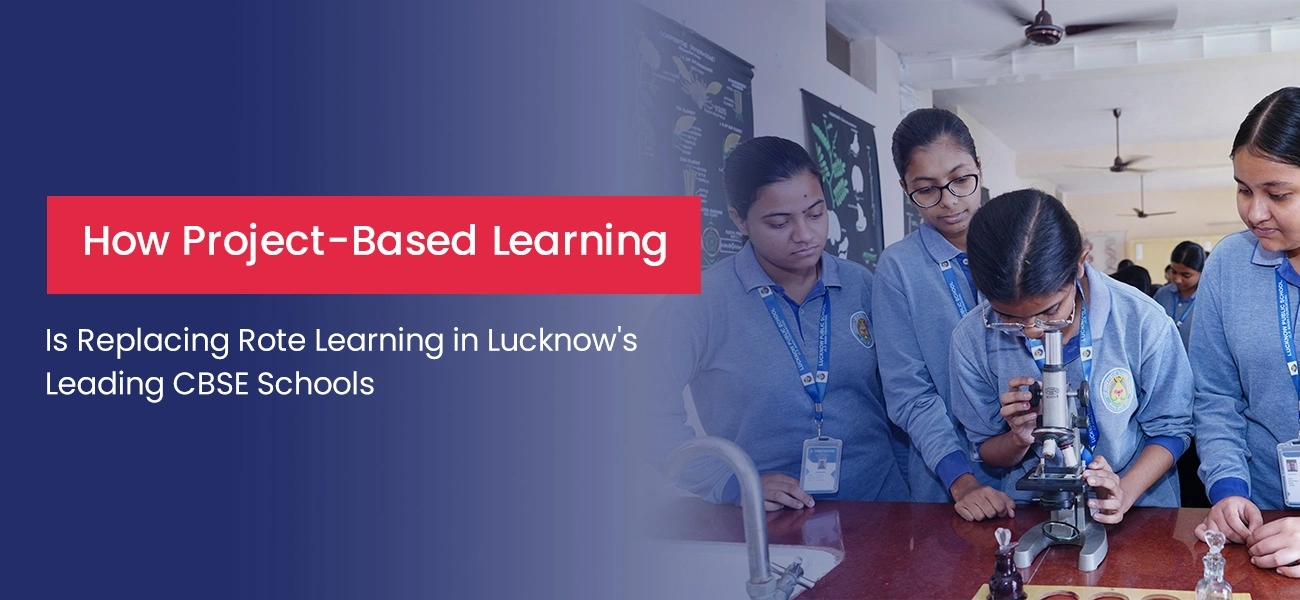
The Core Problem with Rote Learning in Modern Education
To truly understand why the top CBSE schools in Lucknow are changing their teaching methods, it helps to examine the limitations of traditional memorisation. When a child memorises a scientific formula or a historical event purely to pass a test, that information is stored in their short-term memory. Once the report card is printed, that knowledge often vanishes.
This traditional framework creates a significant learning gap:
- Passive Retention: Students become passive consumers of information rather than active explorers, which can slowly diminish their natural curiosity.
- Lack of Contextual Understanding: A child might easily memorise the three laws of motion but struggle to explain how those same principles apply to the safety mechanics of a moving vehicle.
- Diminished Soft Skills: Sitting silently in rows leaves very little opportunity for students to develop vital life skills like team collaboration, public speaking, and project management.
Modern national frameworks, including the National Education Policy (NEP), explicitly call for a shift away from rote methods. Research from the Harvard Graduate School of Education indicates that interactive, visual, and experiential learning methods can improve conceptual comprehension by up to 40%.
By replacing passive listening with active doing, schools can help students build neural pathways that transform abstract facts into permanent, practical understanding.
What Does Project-Based Learning Look Like in the Classroom?
Project-based learning does not mean simply replacing textbooks with casual arts-and-crafts activities or assigned homework posters. True PBL is a highly structured, rigorous, and multidisciplinary teaching method. It challenges students to solve open-ended, real-world problems over an extended timeframe, integrating multiple school subjects into a single, cohesive project.
Consider how a middle-school physics lesson changes under this modern approach. Instead of merely reading a textbook chapter on electrical circuits and conductors, students might be tasked with designing a miniature, energy-efficient smart home model.
To complete this assignment successfully, they must calculate voltage requirements using mathematics, select sustainable building materials using environmental science, and write a clear technical report explaining their design choices using their language skills.
This hands-on journey changes the teacher's role from a traditional lecturer to an active learning facilitator and project manager. Students take independent ownership of their workflow, learning how to research accurately, test out different ideas, manage their time effectively, and view mistakes as a natural part of the problem-solving process.
Transforming Classrooms into Active Spaces at Lucknow Public School
At Lucknow Public School, experiential learning is a foundational philosophy that guides daily classroom interactions across our campuses, including our South City and Ansal API branches. We believe that the walls of a classroom should be porous, allowing real-world experiences to enrich our academic curriculum.
Our students don't just study environmental science from a printed page; they actively run our annual green campus and eco-gardening initiatives. Through hands-on workshops like "Transforming Waste to Worth", they learn the mechanics of sustainable waste systems by creating functional recycling setups right on campus.
Similarly, civics comes alive through organised mock parliaments, while mathematics and economics are mastered through practical field assignments where students interview local business owners to analyse real profit margins and supply chains.
By combining the structural guidelines of the CBSE board with our deep-rooted institutional ethos of Vidya (knowledge) and Sadvidya (righteous knowledge), LPS ensures that students maintain excellent academic focus while building genuine, long-term confidence.
Our balanced continuous evaluation system ensures that a student's intelligence and progress are measured by their analytical reasoning and creative insights rather than exam-day stress.
The Strategic Advantage of a Project-Driven Education
When parents look for the best school in Lucknow, they are investing in their child's long-term future. A project-driven CBSE education provides distinct advantages that help students stand out as they transition into higher studies and professional careers:
Seamless Preparation for National Competitive Exams
Because national competitive exams like JEE, NEET, and CUET focus heavily on conceptual clarity and applied problem-solving, students trained in project-based learning are naturally at an advantage. They know how to analyse complex questions rather than just looking for memorised formulas.
Developing In-Demand 21st-Century Skills
Working in structured teams helps students naturally build key professional skills that cannot be taught through textbooks alone—including active listening, clear communication, conflict resolution, and collaborative leadership.
Setting a Benchmark for Educational Excellence
The transition away from rote memorisation across Lucknow's educational landscape marks a vital step forward for the next generation of learners. True academic excellence is not about how flawlessly a student can memorise an answer key; it is about how confidently they can navigate an unfamiliar challenge, ask meaningful questions, and design a workable solution.
By embedding structural project work, modern smart-board technology, and real-world problem-solving into our daily curriculum, Lucknow Public School continues to set a clear benchmark for holistic development. We remain deeply dedicated to nurturing kind, curious, and future-ready individuals who are fully prepared to step out and make a lasting, positive impact on the world.
Discover the Learning Difference at Lucknow Public School
Are you looking for an academic environment that nurtures your child's natural curiosity and builds real-world problem-solving skills? Give your child the advantage of a balanced, value-based, and future-ready education at one of our modern campuses across Lucknow. Our dedicated admissions team is ready to guide you through our enrolment criteria, campus facilities, and interactive learning paths.
Connect with the admissions office at Lucknow Public School today to schedule your personalised campus tour and explore our modern educational approach first-hand.

Written by:Vivek