
blog detail
- Home
- blog detail
 June 24, 2026
Understanding Formative vs Summative Assessment: A Guide for Parents in Unnao
Unnao is changing fast. New colonies are coming up near the Lucknow-Kanpur stretch, more families are settling in for jobs and business, and almost every parent here wants one thing above everything else: a real shot at a good education for their child. Education has always been the fastest ladder out of uncertainty, and in a city growing this quickly, the school you pick today decides a lot about tomorrow.
But here's the catch. Most parents judge a school by its results day. Marks. Percentages. Toppers' list on the noticeboard. Fair enough, results matter. Yet results are only the last chapter of a much longer story, and that story is written through assessment, the quizzes, projects, group discussions, oral questions, and yes, the big terminal exams too. Understanding how formative and summative assessment actually differ can change how you read your child's progress.
At Lucknow Public School, the top CBSE board school in Unnao, we get asked this at almost every parent-teacher meeting. "Ma'am, why does the report card only show exam marks but the teacher's remarks talk about something else entirely?" Good question. Let's break it down properly.
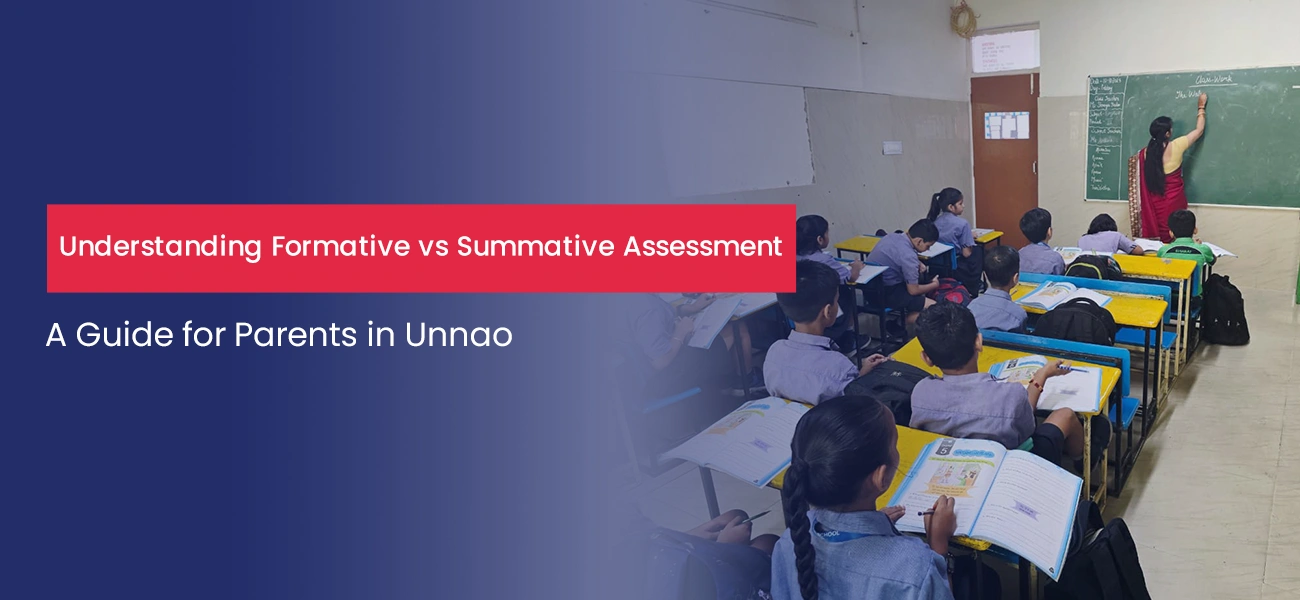
What Exactly Is Formative Assessment?
Think of formative assessment as the ongoing checkup. It happens while learning is still happening, not after.
A class quiz on photosynthesis halfway through the chapter? Formative. A worksheet that helps the teacher see who's struggling with fractions before the unit test? Formative. Group projects, oral questions in class, even a five-minute exit ticket asking "what's one thing you didn't understand today," all of it counts as formative.
The purpose isn't to grade harshly. It's diagnostic. CBSE's own Continuous and Comprehensive Evaluation framework built this in formally, assigning Formative Assessments a 40% weightage against 60% for Summative Assessments across two academic terms, according to a CCE breakdown published by Flip Education in January 2026. That ratio wasn't random, it was designed so a real chunk of evaluation comes from how a child learns, not just what they score on one final day.
Does this mean formative assessment has no stakes? Not exactly, it's low stakes, but low stakes doesn't mean low importance. It might matter more, because it's the only window a teacher gets into a child's thinking while there's still time to fix gaps.
Why It Matters More Than Most Parents Realise
Would you rather know your child is struggling with long division in October, or find out in March when the final exam paper comes back? Obviously October. That's the entire point of formative assessment.
What Is Summative Assessment, Then?
Summative is the "after the fact" evaluation. The final unit test. The term exam. The board exam, for that matter.
It measures what's been retained, what's been mastered, and how much of the syllabus genuinely stuck. There's no going back once it's done, which is exactly why it carries more weight in the traditional system. HMH education researchers describe it simply: summative assessment occurs after the fact, measuring how much a student has learned, retained, and mastered over the course of study.
This is the part that ends up on the report card most parents look at first, and honestly, it should. Final exams test whether a concept has truly been internalised, not just understood for a day.
So Which One Is Better?
Trick question. Neither. They're not competing systems, they're complementary ones. A school relying only on summative testing risks missing struggling students until it's too late to help. A school relying only on formative checks, without ever testing under exam conditions, risks producing students who panic the moment a real exam paper lands in front of them.
The Bigger Shift Happening Right Now
Here's something every Unnao parent should know about for 2025-26.
CBSE and NCERT, under the National Education Policy 2020, have been pushing a new model called the Holistic Progress Card, or HPC. It's not a replacement for assessment, it's a redesign of how it's reported. Instead of one number summing up a whole year, the HPC captures cognitive, social, emotional, and physical growth together. As per coverage from Vidyalaya's education research desk, more than 25,000 best CBSE schools in Unnao are expected to use the Holistic Progress Card framework by 2025 as the NEP 2020 rollout continues nationally. That's not a small number, and it's a genuine shift in how schools, including ones right here in Unnao, are expected to talk to parents about progress.
In practice, report cards are slowly moving away from a single percentage and toward an actual conversation about your child, how they think, how they collaborate, how they cope with pressure.
Does Unnao Need This Shift Even More?
This is where local context matters, and we won't sugarcoat it.
Census-linked district data places Unnao's overall literacy rate at 66.37%, with male literacy at 75.05% and female literacy notably lower at 56.76%, based on figures compiled in the official Unnao district factbook. That gap isn't unique to Unnao, but it's real, and it's measurable.
Separate spatial research published in Nature's Humanities and Social Sciences Communications places Unnao in the "low disparity" category for gender gap in literacy, with a disparity index of 0.36, trailing better-performing districts like Hapur and Kanpur Nagar.
What does this tell us? The foundation matters. A child tracked closely, formatively, from an early age, especially girls who statistically face a steeper gap, has a far better shot at staying engaged through to board exams and beyond. This isn't about blame. It's about why the assessment philosophy a school follows genuinely counts for something in a city like Unnao.
How Lucknow Public School Approaches This
We don't believe in choosing one over the other, and honestly, CBSE doesn't allow that flexibility either.
At LPS, our teachers run regular formative check-ins, class participation, concept-mapping exercises, peer review sessions, alongside structured summative term exams that prepare students for the rigour of board-level assessment later on. We're a CBSE board school in Unnao, so our assessment calendar follows the national framework, term-wise FA and SA cycles, NEP-aligned reporting, and increasingly, HPC-style descriptive feedback for younger learners.
Parents often ask us directly: "Which is the best CBSE school in Unnao for this kind of balanced approach?" We won't claim to be the only answer, that wouldn't be honest. What we will say is that among the schools in Unnao, we've built our pedagogy around making sure no child is assessed once and forgotten about for a term. Continuous tracking, parent-teacher dialogue, and exam preparation run in parallel, not in sequence.
Is that the only thing that makes a school good? No, infrastructure matters, teacher quality matters. But assessment philosophy is the part most parents never ask about, and it often decides whether a child grows confident or grows anxious about every test.
A Few Honest Thoughts for Unnao Parents
Don't panic over one bad unit test. That's formative, meant to show gaps, not predict failure. Do pay attention if a pattern repeats term after term, that's the real signal worth acting on. And do ask your child's school how they balance both. If a school only talks percentages and never mentions ongoing classroom feedback, notice that too.
The top CBSE board school in Unnao, the ones genuinely investing in NEP-aligned, balanced assessment, are setting students up for board exams without burning them out before Class 10 even arrives. That's not a promise of guaranteed top scores, no honest school can promise that. It's a commitment to making sure every child is seen clearly, not just scored once and left to figure out the rest.

Written by:Vivek