blog detail
- Home
- blog detail
 Nov 24, 2026
Why Does My Child Forget What They Studied Yesterday? Understanding Memory and Revision
A child may spend an entire evening studying a chapter, answer questions correctly before going to bed and then struggle to remember the same information the following morning. For parents, this can be frustrating.
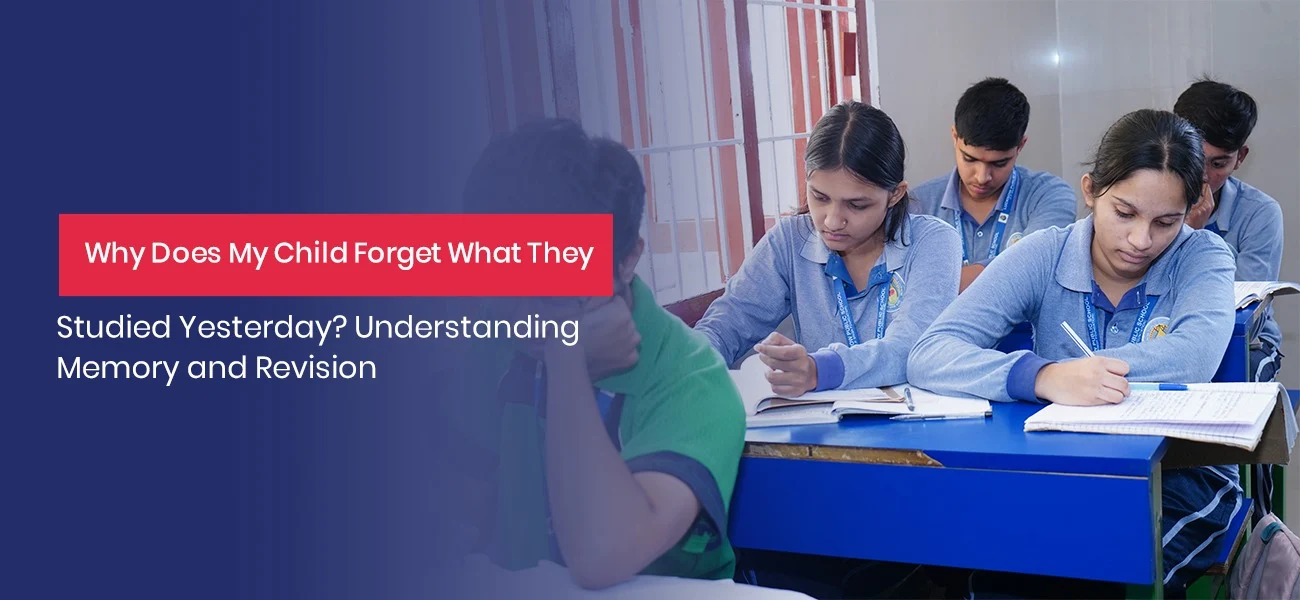
It may appear that the child was not paying attention or did not study seriously enough. However, forgetting is a normal part of how memory works. Learning does not become permanent simply because a student has read a chapter once. Families considering LPS High School and other educational options should understand how revision, recall and regular practice contribute to long-term learning.
The important question is not whether a child forgets something, but whether they are using effective methods to remember and apply what they have learned.
Why Do Children Forget What They Studied?
Memory involves taking in information, retaining it and retrieving it when required. Each stage can be affected by several factors, including attention, understanding, sleep, stress and the way a child revises.
A student may forget a lesson for different reasons:
- Passive reading: Reading the same paragraph repeatedly may create a feeling of familiarity without ensuring that the student can recall it independently.
- Limited understanding: Memorising words without understanding their meaning makes it harder to use the information later.
- Too much information at once: Studying several chapters in one sitting can make revision tiring and difficult to organise.
- Long gaps between revision sessions: Information may become harder to retrieve when it is not revisited.
- Distractions: Frequent interruptions can affect attention during the initial learning process.
- Stress and tiredness: A child who is anxious or sleep-deprived may find it harder to concentrate and recall information.
Parents should avoid assuming that forgetting always indicates a lack of effort. It may be a sign that the child's study method needs to change.
Is Your Child Memorising or Actually Understanding the Lesson?
One useful way to assess learning is to ask the child to explain a concept without looking at the textbook. If they can describe it in their own words, give an example or connect it with something they already know, they are demonstrating a deeper level of understanding.
For example, after studying a science chapter on evaporation, a child should be able to explain why wet clothes dry in sunlight. Simply repeating the textbook definition may not show whether the concept has been understood.
Parents can try these questions:
- Can you explain this topic without reading it?
- Can you give an example from everyday life?
- Why does this happen?
- How is this connected to the previous chapter?
- What part of the lesson is still confusing?
If the child struggles to explain the idea, revisit the concept before asking them to memorise more details.
Understanding why a child forgets what they study begins with observing how they learn, not simply how many hours they spend with books.
Why Spaced Revision and Active Recall Work Better
Research on learning has identified two useful strategies: spaced practice and retrieval practice. A review published in Nature Reviews Psychology explains how revisiting information over time and actively retrieving it from memory can support learning and retention. [1]
Spaced revision means studying a topic more than once, with gaps between sessions. Instead of completing all revision in one evening, a student can revisit the same lesson the next day, several days later and again before an assessment.
Active recall means trying to remember information without immediately looking at the notes. A student can close the book and write down key points, answer questions from memory or explain the topic aloud.
These methods make revision more active. They also help students identify what they know and what still needs attention.
A simple revision pattern could look like this:
- Day 1: Learn the topic and understand the main ideas.
- Day 2: Recall the important points without looking at the book.
- Day 4: Attempt a short quiz or solve related questions.
- Day 7: Review difficult areas and explain the topic again.
- Before the test: Practise application-based questions and revisit weak areas.
The schedule can be adjusted according to the subject, difficulty and the child's progress.
Practical Revision Techniques That Parents Can Encourage
Effective revision does not always require longer study hours. It requires the right activity at the right time.
Parents can encourage these revision techniques for students:
1. Teach-back method
Ask the child to explain a lesson as if they were teaching it to someone younger. This helps reveal gaps in understanding.
2. Short self-tests
After studying a topic, ask the child to answer five questions without looking at the textbook. Check the answers together and revisit mistakes.
3. Flashcards
Write a question on one side and the answer on the other. Flashcards work well for vocabulary, definitions, dates, formulas and short factual information.
4. Mind maps
A mind map can help children organise a topic into connected ideas. It is particularly useful when a chapter contains several related concepts.
5. Practice questions
Solving questions helps students apply what they have learned. Encourage them to understand why an answer is correct rather than simply checking the final result.
6. Mixed-topic practice
Once a child understands individual topics, mixing questions from different chapters can help them decide which concept or method is needed.
The most suitable method may differ by subject. A child studying mathematics may need regular problem-solving practice, while a student learning history may benefit from timelines, recall questions and explanation.
How Can Schools Support Better Memory and Learning Habits?
Teachers influence how students learn, practise and revise. Lessons that include questioning, discussion, examples and regular feedback can help students understand information rather than depend entirely on memorisation.
CBSE's competency-based education framework highlights the application of knowledge, formative assessment and student reflection. These practices can help teachers identify whether students understand a concept and where additional support may be needed. [2]
Parents evaluating a top secondary school in Lucknow can ask how teachers monitor learning after a chapter has been completed. Useful questions include:
- Are students given regular opportunities to recall earlier lessons?
- Do teachers identify concepts that students commonly find difficult?
- Are practice questions used before major assessments?
- How are students guided when they repeatedly make the same mistakes?
- Do teachers share revision guidance with parents and students?
Families comparing a secondary school in Lucknow should also consider whether students are encouraged to ask questions and clarify doubts before moving to more advanced topics.
When exploring lps high school, parents can seek information from the relevant campus about its teaching approach, assessment practices and academic support. Specific revision schedules or classroom methods should be confirmed directly with the school rather than assumed.
What Can Parents Do When a Child Keeps Forgetting Lessons?
Repeated forgetting can make children lose confidence, particularly when they feel they have already spent enough time studying. Parents can help by creating a predictable routine without turning every evening into a test.
Start with a few manageable changes:
- Set a regular study time with short breaks.
- Keep the study area reasonably free from distractions.
- Encourage the child to revise a small section rather than an entire chapter at once.
- Ask them to recall information before reopening their notes.
- Allow sufficient time for sleep and recreation.
- Notice which topics are repeatedly difficult and discuss them with the teacher.
If the child has persistent difficulty remembering instructions, concentrating or retaining information across different settings, discuss the concern with their teacher. If necessary, seek guidance from a qualified professional. A child's learning difficulty should not be diagnosed through a single incident of forgetting.
Final Word: Help Children Build a Revision Routine That Supports Memory
Forgetting a lesson does not mean that a child has failed to learn. It often means that the information needs to be revisited, understood more clearly or practised through active recall. Parents can support better learning by encouraging spaced revision, self-testing and explanation instead of relying only on repeated reading.
Families considering LPS High School should look at how teaching, assessment and academic support help students build consistent learning habits. A strong learning environment should encourage children to understand concepts, recognise gaps and improve through practice.
Ultimately, Lucknow Public School can be part of a child's academic journey, while regular revision, supportive guidance and healthy routines help turn classroom learning into lasting understanding.
Summary
This blog explains why children may forget lessons despite spending time studying. It discusses the role of attention, understanding, tiredness and revision gaps, then introduces spaced practice and active recall as useful learning strategies. It also provides practical revision methods, questions parents can ask schools and ways to support children who struggle with memory. The central message is that consistent, active revision is more useful than relying only on repeated reading.
References
[1] Shana K. Carpenter, Steven C. Pan and Andrew C. Butler, The Science of Effective Learning with Spacing and Retrieval Practice, Nature Reviews Psychology, 2022.
[2] Central Board of Secondary Education, Competency-Based Education.
[3] Lucknow Public School, Official Website.

Written by:Kundan Yadav